


Blog
RTLS in Healthcare: Patient Safety, Staff Efficiency & Hospital Operations

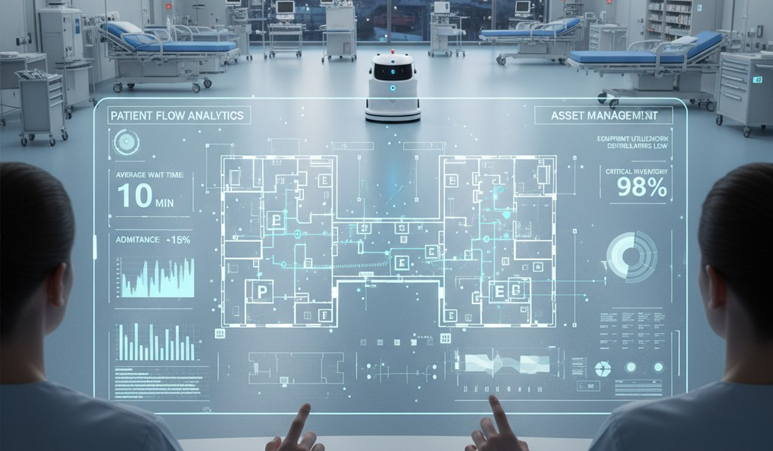
RTLS in Healthcare: How Real-Time Location Systems Improve Patient Safety and Hospital Efficiency
Real-time location systems (RTLS) in healthcare use location data from tags, sensors, and software to provide visibility into the location of patients, personnel, medical equipment, and other assets. By making location information available in real time, healthcare organizations can support patient safety, improve staff workflows, locate critical equipment faster, and coordinate operations across departments.
Healthcare facilities can use RTLS for a range of applications, including medical equipment tracking, patient location visibility, wandering alerts, staff safety, emergency assistance, patient flow, asset utilization, and location-based workflow automation.
The value of RTLS is not simply knowing where something is. It is using real-time location information to support faster decisions, better coordination, safer workflows, and more efficient use of healthcare resources.
In this guide, we explain what RTLS is, how it works in healthcare, its key use cases and benefits, and how BLE-based RTLS can support different healthcare environments.
What Is RTLS in Healthcare?
Real-time location systems (RTLS) are technologies used to determine and monitor the location of tagged people, equipment, or other assets within a defined environment.
In healthcare, RTLS can provide real-time visibility into the location and movement of:
Patients
Healthcare personnel
Medical equipment
Mobile assets
Beds and other resources
Critical supplies and devices
A typical healthcare RTLS consists of three core elements:
1. Tags and Wearables
BLE tags, badges, or other devices can be attached to medical equipment, worn by staff or patients, or associated with other assets that require location visibility.
2. Locators, Scanners, Anchors, and Gateways
These infrastructure devices detect signals from tags and provide the location data needed by the RTLS system.
3. RTLS Software
The software processes location information and can present it through maps, dashboards, alerts, rules, reports, and integrations with other healthcare or operational systems.
Depending on the application and required accuracy, healthcare organizations can use technologies such as Bluetooth Low Energy (BLE), RSSI, Angle of Arrival (AoA), BiLink, or hybrid positioning.
This allows an RTLS deployment to be designed according to the facility layout, application requirements, coverage needs, and required positioning accuracy.
How Does RTLS Work in a Hospital?
An RTLS deployment typically follows a simple data flow:
Tag → BLE Infrastructure → Location Processing → RTLS Platform → Dashboard, Alert, or Integrated Workflow
For example, a BLE tag attached to a medical device can transmit its signal to nearby BLE scanners or anchors. The RTLS platform processes that information and determines the device's location or zone.
The resulting information can then be used to:
Display the asset on a digital map
Identify which room or area contains an asset
Trigger a location-based alert
Notify designated personnel
Record movement or location events
Support workflow automation
Provide data for operational analysis
The same basic architecture can support different healthcare applications, from equipment visibility to patient safety and staff emergency assistance.
What Are the Main RTLS Use Cases in Healthcare?
Healthcare organizations can apply RTLS to multiple operational and safety challenges.
Medical Equipment Tracking
Medical equipment often moves between patient rooms, departments, storage areas, treatment areas, and other parts of a facility. When staff cannot quickly determine where an available device is located, valuable time can be spent searching.
RTLS provides real-time location visibility for tagged equipment, allowing authorized staff to identify where an asset is located without relying entirely on manual searches or verbal coordination.
Depending on the deployment, RTLS can help healthcare organizations:
Locate mobile equipment more quickly
Improve visibility of available assets
Understand equipment utilization
Reduce unnecessary duplicate purchases
Support maintenance workflows
Monitor movement between departments
Equipment such as infusion pumps, wheelchairs, monitors, carts, and other mobile assets can be incorporated into an RTLS deployment according to the organization's requirements.
Patient Safety and Location Visibility
RTLS can provide healthcare teams with real-time visibility into the location of patients who require additional monitoring or location-based safety workflows.
Wearable tags can be associated with patients and configured with defined zones or rules. When a patient enters or leaves a designated area, the system can generate an alert for authorized personnel.
This can support workflows such as:
Restricted-area alerts
Wandering-prevention workflows
Patient movement visibility
Entry and exit detection
Patient transfer coordination
Location-based notifications
RTLS should complement established clinical and safety procedures rather than replace them.
Patient Fall Detection
Some RTLS-enabled wearable devices can incorporate motion or acceleration sensing to identify potential fall events.
When a qualifying event is detected, the system can generate an alert and provide associated location information to the appropriate personnel.
This can help healthcare teams understand where assistance may be required and support faster coordination during an incident.
The specific capabilities of fall detection depend on the tag hardware, sensor configuration, software rules, and deployment environment.
Staff Safety and Emergency Assistance
Healthcare workers may encounter situations where they need immediate assistance, particularly in environments such as psychiatric, behavioral health, emergency, or isolated care areas.
Wearable staff devices with an SOS function can allow personnel to initiate an emergency alert while carrying the device with them.
An RTLS-enabled emergency workflow can associate the alert with the staff member's location, helping designated security or management personnel identify where assistance is required.
This can support:
Staff emergency alerts
Location-enabled SOS workflows
Faster identification of incident locations
Improved coordination between staff and security teams
Incident documentation and response workflows
Patient Flow and Location Visibility
Patients may move between admission areas, examination rooms, laboratories, radiology, operating rooms, wards, and other departments during a hospital visit.
Without location visibility, teams may have limited insight into where patients are within the overall workflow.
RTLS can provide location information that helps authorized teams understand patient movement and identify potential workflow bottlenecks.
When integrated with appropriate operational systems, RTLS data can support:
Patient transfer coordination
Department-to-department movement
Workflow visibility
Room and area utilization
Patient flow analysis
Operational planning
RTLS does not replace a hospital's clinical information or patient management systems. Instead, location data can complement those systems by adding real-time physical-location information.
Asset Utilization and Maintenance
Knowing where equipment is located is only one part of asset management.
Historical RTLS data can also help organizations understand how equipment moves through a facility and how assets are being used.
This information can support:
Asset utilization analysis
Maintenance planning
Equipment allocation
Resource planning
Identification of frequently moved assets
Identification of operational bottlenecks
By combining real-time location information with historical data, healthcare organizations can make more informed decisions about their physical resources.
Environmental and Temperature Monitoring
Healthcare facilities contain areas where environmental conditions can be important for equipment, medicines, laboratory materials, and other sensitive resources.
BLE devices with environmental sensors can monitor parameters such as:
Temperature
Humidity
Pressure
Air-quality-related measurements
When integrated into an RTLS and IoT environment, sensor data can be monitored and used to trigger alerts when configured thresholds are exceeded.
This can support applications such as pharmaceutical storage, laboratory environments, critical equipment areas, and temperature-sensitive workflows.
How Does RTLS Improve Patient Safety?
RTLS can contribute to patient safety by providing healthcare teams with additional real-time information about the physical location of patients, staff, and relevant resources.
For example, location-based rules can be used to generate alerts when a tagged patient enters a restricted area, while wearable devices can support emergency or fall-related workflows.
RTLS can therefore support patient safety through:
Real-time location visibility
Geofencing and zone-based alerts
Wandering-prevention workflows
Potential fall-event detection
Patient movement visibility
Emergency notifications
Location information during incidents
The specific safety workflow depends on the RTLS technology, tag capabilities, software configuration, and clinical procedures implemented by the healthcare organization.
Research on RTLS in healthcare has identified applications in process and quality improvement, workflow analysis, and patient safety, although implementation and data-analysis requirements vary between healthcare environments.
How Does RTLS Improve Staff Efficiency?
Healthcare professionals frequently spend time locating equipment, coordinating movement between departments, responding to incidents, and managing resources.
RTLS can reduce some of the manual effort associated with these activities by providing a shared source of real-time location information.
For example, instead of contacting multiple departments to locate a mobile device, authorized staff can use the RTLS interface to identify its current location.
RTLS can support staff efficiency by helping teams:
Locate equipment
Identify available resources
Coordinate patient movement
Respond to location-based alerts
Identify staff or assets in defined areas
Analyze workflow and movement patterns
The objective is not to monitor every movement unnecessarily. Rather, RTLS can provide location intelligence where it has a clear operational, safety, or workflow purpose.
Why Use BLE RTLS in Healthcare?
Bluetooth Low Energy (BLE) is well suited to many indoor positioning and asset-visibility applications because BLE devices can provide location signals while supporting low-power operation and flexible deployment.
A BLE RTLS architecture can connect tags, badges, scanners, anchors, gateways, and RTLS software into a location intelligence system.
Different BLE positioning approaches can be selected depending on the application.
BLE RSSI
RSSI-based positioning can provide proximity, zone, and location information based on received signal strength. It can be suitable for applications where room- or area-level visibility is sufficient.
BLE Angle of Arrival (AoA)
AoA uses the direction of an incoming BLE signal to provide more precise indoor positioning than basic proximity-based approaches. It can be used where more detailed positioning is required.
BiLink
BiLink is a specialized BLE RSSI architecture designed to support reliable room- and zone-level visibility through bidirectional relay communication.
It can be useful in smaller rooms, adjacent spaces, entry points, and transitional areas where room-level presence information is required.
Hybrid BLE RTLS
A healthcare facility does not necessarily need to use one positioning technology everywhere.
A hybrid approach can combine different BLE positioning methods across different areas according to the required accuracy, coverage, infrastructure, and application.
RTLS vs. Manual Location Processes in Healthcare
| Manual Location Process | RTLS-Enabled Approach |
|---|---|
| Staff call or search for equipment | Location is available through the RTLS interface |
| Manual equipment checks | Automated location visibility |
| Verbal coordination between departments | Shared real-time location information |
| Limited historical location information | Location events can be stored for analysis |
| Manual response to some location events | Configurable location-based alerts |
| Difficult to identify movement patterns | Location data can support workflow analysis |
RTLS is therefore not simply a replacement for manual processes. It provides a digital layer of location intelligence that can be integrated into existing healthcare workflows.
What Are the Benefits of RTLS in Healthcare?
The benefits of RTLS depend on the application, technology, deployment design, and operational processes surrounding the system.
Common areas of value include:
Patient Safety
Location visibility and configurable alerts can support workflows involving vulnerable patients, restricted areas, emergencies, and other safety events.
Staff Efficiency
Staff can spend less time searching for equipment or coordinating basic location information manually.
Equipment Visibility
Healthcare organizations can gain greater visibility into the location and movement of mobile equipment.
Resource Utilization
Location data can help organizations understand how assets and spaces are being used.
Emergency Coordination
Location-enabled SOS and alert workflows can provide additional context during emergency events.
Workflow Optimization
Historical location information can help organizations identify movement patterns, delays, and operational bottlenecks.
Integration
RTLS location information can be connected to other applications and operational systems through appropriate APIs and integration methods.
How Sentrax Supports Healthcare RTLS Deployments
Sentrax provides a BLE-based RTLS ecosystem designed to support real-time location and positioning across healthcare and other indoor environments.
The ecosystem can combine:
BLE RSSI infrastructure
BLE Angle of Arrival infrastructure
BiLink room-level positioning
Hybrid positioning
BLE asset and wearable tags
Environmental sensing
RTLS and IoT management software
APIs and integration capabilities
Sentrax's SOLIX RTLS & IoT Management Platform acts as the software layer that processes location and sensor data from connected infrastructure and makes that information available to applications and workflows.
Healthcare deployments can therefore be designed around the specific requirements of the facility rather than using a single positioning approach for every application.
For example:
BLE RSSI can support proximity and zone-level visibility
BiLink can provide room-level asset and personnel visibility
BLE AoA can support more precise positioning
Hybrid BLE RTLS can combine different positioning approaches across a facility
This allows healthcare organizations to align RTLS infrastructure with their required accuracy, coverage, operational workflows, and integration requirements.
Frequently Asked Questions About RTLS in Healthcare
What is RTLS in healthcare?
RTLS, or real-time location systems, uses tags, sensors, infrastructure, and software to determine the location of people, equipment, or assets within a defined healthcare environment. It can support applications such as equipment tracking, patient location visibility, staff safety, patient flow, and workflow optimization.
How does RTLS improve patient safety?
RTLS can provide real-time location visibility and support location-based alerts for applications such as wandering prevention, restricted-area monitoring, emergency assistance, and potential fall-event detection.
What can RTLS track in a hospital?
Depending on the deployment, RTLS can provide location visibility for medical equipment, mobile assets, patients, healthcare personnel, beds, and other tagged resources.
Can RTLS be used for medical equipment tracking?
Yes. RTLS can provide real-time visibility into the location of tagged medical equipment, helping authorized staff locate assets and supporting utilization and maintenance workflows.
Can RTLS detect patient falls?
Some RTLS wearable devices include motion or acceleration sensors that can be configured to identify potential fall events. The exact detection capability depends on the tag hardware, sensor configuration, software, and deployment.
Can RTLS help prevent patient wandering?
RTLS can support wandering-prevention workflows by using wearable tags, defined zones, and location-based alerts. When a tagged patient enters or leaves a configured area, the system can notify designated personnel.
How does RTLS improve staff efficiency?
RTLS can reduce time spent locating equipment and provide shared location information that supports patient movement, resource coordination, emergency response, and workflow analysis.
What is BLE RTLS?
BLE RTLS uses Bluetooth Low Energy devices and infrastructure to provide indoor location information. Depending on the system architecture, BLE can support proximity, zone-level, room-level, or more precise positioning.
What is the difference between RTLS and GPS in healthcare?
GPS is primarily designed for outdoor positioning, while RTLS is commonly used for location visibility within defined indoor environments. Healthcare facilities can use RTLS technologies such as BLE RSSI and AoA to provide indoor positioning where GPS may not provide the required coverage or accuracy.
How accurate is healthcare RTLS?
RTLS accuracy depends on the positioning technology, infrastructure layout, device capabilities, environmental conditions, and deployment design. Some applications require only proximity or room-level information, while others may require more precise positioning.
Conclusion
RTLS in healthcare provides a digital layer of real-time location intelligence that can support patient safety, staff workflows, equipment visibility, and hospital operations.
From locating medical equipment and monitoring patient movement to supporting staff emergency assistance and optimizing workflows, RTLS can be applied to a wide range of healthcare requirements.
BLE-based RTLS provides additional flexibility because healthcare organizations can choose different positioning approaches according to their application and environment, including BLE RSSI, BiLink, BLE AoA, and hybrid positioning.
For healthcare organizations evaluating RTLS, the most important consideration is not simply whether a system can provide a location. It is whether the location data can be accurately delivered, meaningfully interpreted, and integrated into the workflows where it provides operational or safety value.
Sentrax provides a BLE RTLS ecosystem combining location infrastructure, tags, positioning technologies, and the SOLIX RTLS & IoT Management Platform to help organizations build location-aware healthcare applications.
Explore Sentrax Healthcare RTLS →
https://sentrax.com/applications/healthcare/