

Use Cases of RTLS and RTLS in
Smart Buildings & Cities
How Does RTLS Work in Smart Buildings?
In a smart building, a real-time location system (RTLS) shows where people and assets are, how rooms are being used, and what the indoor conditions are at any given moment. BLE badges and tags worn by staff or fixed to equipment send short signals. Gateways and locators mounted on ceilings or walls pick those signals up and pass them through SOLIX, the shared middleware, to a high-level RTLS platform from Partners. The platform places each badge or tag on a live floor map and combines that with sensor readings such as temperature, humidity and air quality. Facility teams can then set zones, receive alerts and share the data with access control or building management systems.
By digitizing building operations, RTLS helps:
Automate attendance, visitor and access processes.
Improve how rooms, desks and shared spaces are used.
Keep indoor conditions comfortable and monitored.
- Speed up emergency response and evacuation.
Reduce time spent searching for shared equipment.
Automated Staff Check-In / Check-Out
The Challenge
Offices usually record attendance with card swipes, sign-in sheets or manual entries at reception. These are easy to forget, create queues at peak hours, and give no reliable record of when staff actually entered or left a building or floor.
How Does RTLS Solve This
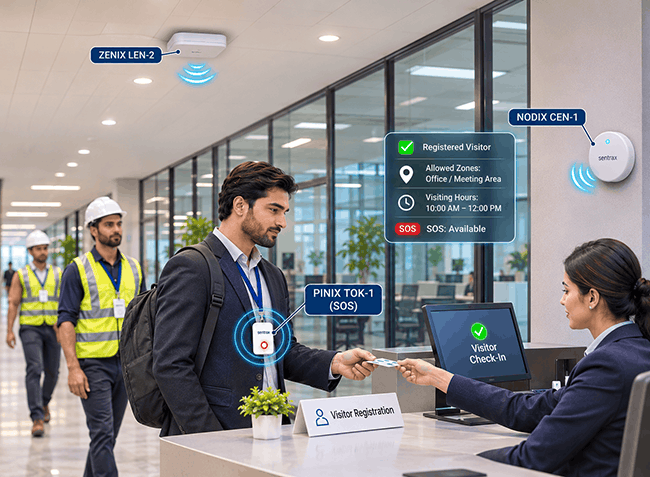
Each employee wears a BLE smart badge. BLE RSSI gateways at entrances and on each floor detect the badge, and several gateways together tell the RTLS platform whether the person is coming in or going out. On floors without a gateway, BiLink relay anchors at entry and exit points detect the badge and relay it to the nearest gateway. The RTLS platform logs each event with a timestamp and shows current presence on the dashboard. The data can be sent through the SOLIX APIs to a partner access control or HR system.
Business Impacts
- Contactless attendance with no manual sign-in
- Accurate in/out records for reporting and audits
- Less time at reception during peak arrival hours
- Live view of who is on site at any moment
Core RTLS System Components
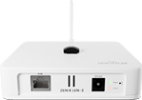


ZENIX LEN-2
Indoor BLE RSSI Gateway
NODIX CEN-1
BiLink BLE Relay Anchor
PINIX TOP-5
Smart Badge
Solix RTLS and IoT
Management APIs
Visitor & Contractor Management
The Challenge
Once visitors and contractors are past reception, facility teams have little visibility of where they go or whether they have left. Checking that they stay within approved areas and visiting hours depends on escorts or manual checks. Contractors who work alone may have no quick way to call for help.
How Does RTLS Solve This
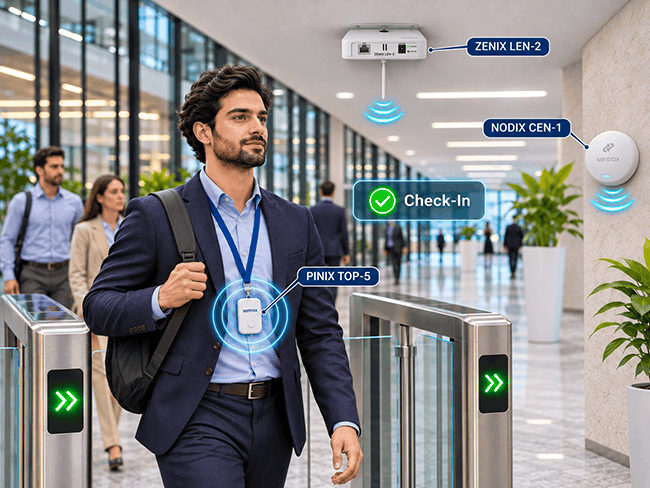
At registration, each visitor or contractor gets a BLE badge linked to their approved zones and visiting hours. BLE AoA locators follow the badge’s position, and BiLink relay anchors confirm which room it is in. The RTLS platform compares this against the permitted zones. If a badge enters an area it is not cleared for, or stays past its time window, security gets an alert. Contractors can press the badge’s SOS button to send an alert with their location.
Core RTLS System Components

ZENIX LEN-2
Indoor BLE RSSI Gateway
NODIX CEN-1
BiLink BLE Relay Anchor
PINIX TOK-1
Smart Badge
with SOS button
Solix RTLS and IoT
Management APIs
Business Impacts
- Better security around visitors and third-party staff
- Fewer escorts and manual checks needed
- Faster help for contractors working alone
- Complete visit records for compliance
Restricted Area Access Monitoring
The Challenge
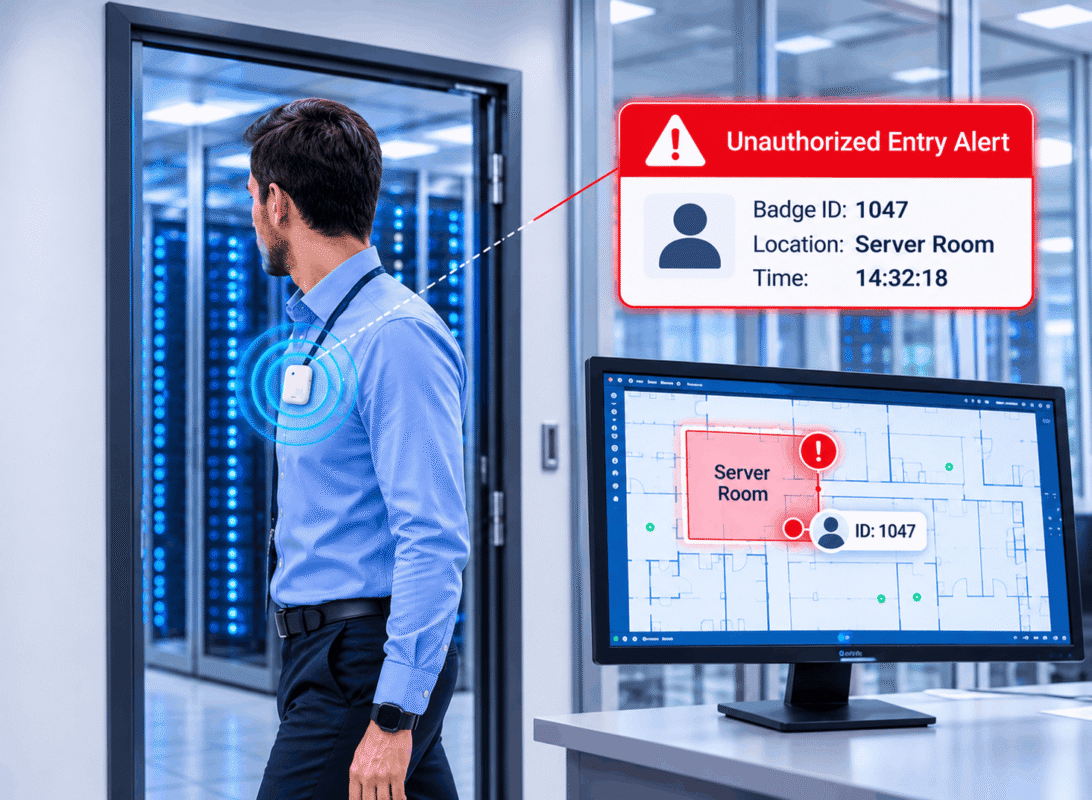
Server rooms, plant rooms, labs and executive floors need to be protected. Door access control records who opened a door, but not who followed someone in or who stayed inside afterwards. Security teams often find out about unauthorized access only after the fact.
How Does RTLS Solve This
Staff wear personnel badges assigned to access levels. In the RTLS platform, restricted areas are drawn as geofences. BLE gateways and BiLink relay anchors placed inside the restricted rooms detect every badge that enters them. When a badge without permission enters, the platform raises an alert on the dashboard or by SMS or email, with the badge ID and location. Events can also go to a partner security system through the SOLIX APIs.
Business Impacts
- Real-time detection of unauthorized entry
- Faster security response and investigations
- Accurate logs of who entered each restricted zone and when
- Fewer manual access audits
Core RTLS System Components
ZENIX LEN-2
Indoor BLE RSSI Gateway
NODIX CEN-1
BiLink BLE Relay Anchor
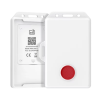
PINIX TOP-6
BLE AoA Smart Badge with RFID
Solix RTLS and IoT Management APIs
Security / Access Control Platform from Partners
Room Occupancy & Space Utilization
The Challenge
Facility managers often lack reliable data on how meeting rooms, desks, and common areas are used. Rooms may be booked but left empty while others are overcrowded. Decisions about office layout, cleaning schedules, and space planning end up based on estimates.
How Does RTLS Solve This
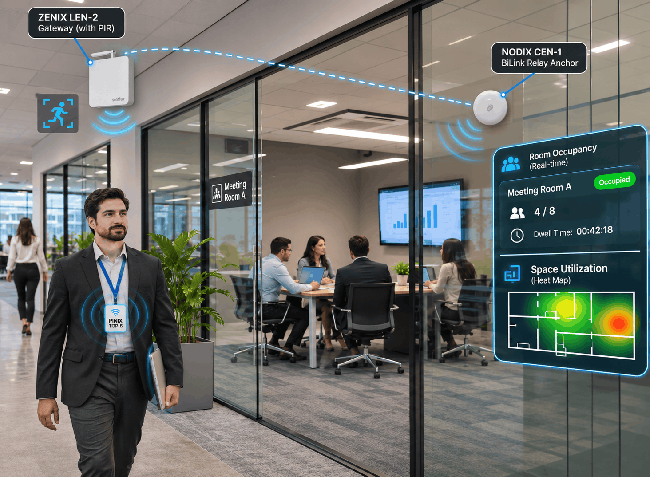
BiLink relay anchors placed in each room detect the badges inside and tag each reading with the room’s ID. They relay this to the nearest ZENIX gateway, which gives room-level visibility without a gateway in every room. The LEN-2 gateway PIR sensor also detects motion in the areas it covers. The RTLS platform turns the data into live occupancy counts, dwell times and heat maps that facility teams use for booking, cleaning and space planning.
Core RTLS System Components
NODIX CEN-1 BiLink BLE Relay Anchor
ZENIX LEN-2 Indoor BLE RSSI Gateway
PINIX TOP-5 Smart Badge
High-Level RTLS Platform from Partners
Solix RTLS and IoT
Management APIs
Business Impacts
- Better use of rooms and desks based on real usage
- Evidence-based space planning and office layout decisions
- Cleaning and services scheduled where they are needed
- Lower infrastructure cost thanks to room-level coverage with fewer gateways
Indoor Environmental Monitoring
The Challenge
Temperature, humidity and air quality can vary widely between floors and rooms, but building systems often rely on a small number of fixed sensors. Poor indoor conditions affect comfort and productivity, and problems are usually noticed only when occupants complain.
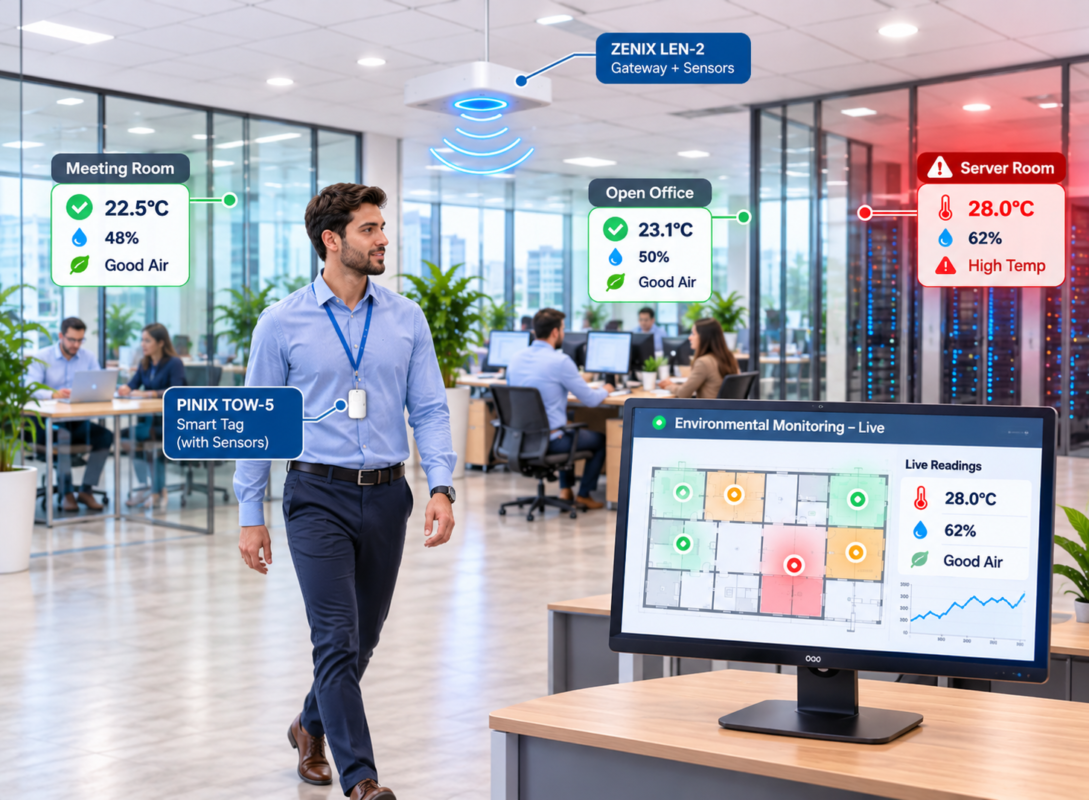
How Does RTLS Solve This
The ZENIX LEN-2 gateways installed for location tracking also measure temperature, humidity, pressure, light and total volatile organic compound (TVOC) levels in each area. The RTLS platform collects these readings, shows them per room and floor, keeps a history, and sends alerts when a value crosses a set threshold. The data can be shared with the building management system over REST APIs or MQTT so HVAC settings can be adjusted to actual conditions.
Business Impacts
- Room-level view of indoor climate and air quality
- Early alerts before conditions affect occupants
- Data for HVAC tuning and energy decisions
- One set of devices for both location tracking and sensing
Core RTLS System Components
ZENIX LEN-2
Indoor BLE RSSI Gateway
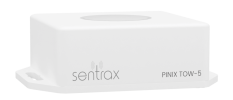
PINIX TOW-5
Asset BLE AoA Tag with Multi-Sensor
(for mobile or spot monitoring)
Solix RTLS and IoT
Management APIs
Building Management System (BMS) from Partner
Emergency Response & Evacuation
The Challenge
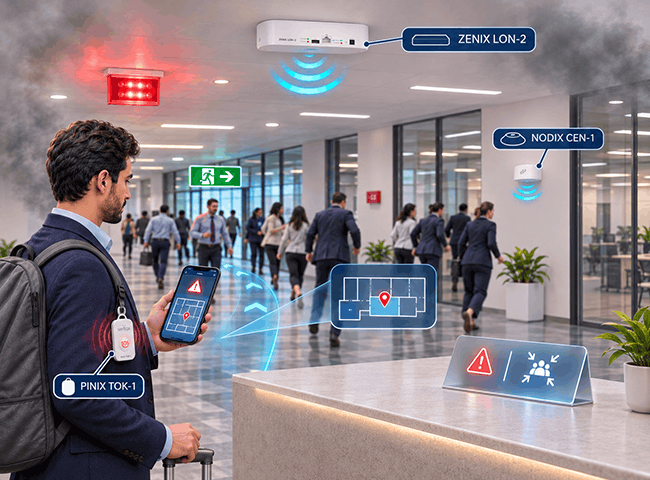
During a fire alarm or evacuation, facility and safety teams need to know quickly who is still inside and where. Manual headcounts at muster points are slow. Responders often have no information about conditions inside each room before they enter.
How Does RTLS Solve This
Staff wear BLE smart badges with an SOS button. The building’s gateways and locators, together with BiLink relay anchors in individual rooms, report each badge’s location to the RTLS platform. During an evacuation, the platform shows who has reached a muster point and who is still inside, with their last known room. Temperature readings from the gateways and locators show conditions by area. A person in trouble can press the SOS button to send an alert with their location, and the data can be passed to a partner emergency management platform.
Core RTLS System Components
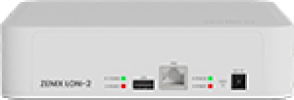
ZENIX LON-2 BLE AoA Indoor Locator
ZENIX LEN-2 Indoor BLE RSSI Gateway
PINIX TOK-1 Smart Badge with SOS button
Solix RTLS and IoT
Management APIs
Emergency Management Platform from Partners
Business Impacts
- Faster accounting for everyone in the building
- Targeted rescue based on last known locations
- Better-informed responders using room-level conditions
- Automated muster reports instead of manual headcounts
Office Asset Tracking
The Challenge
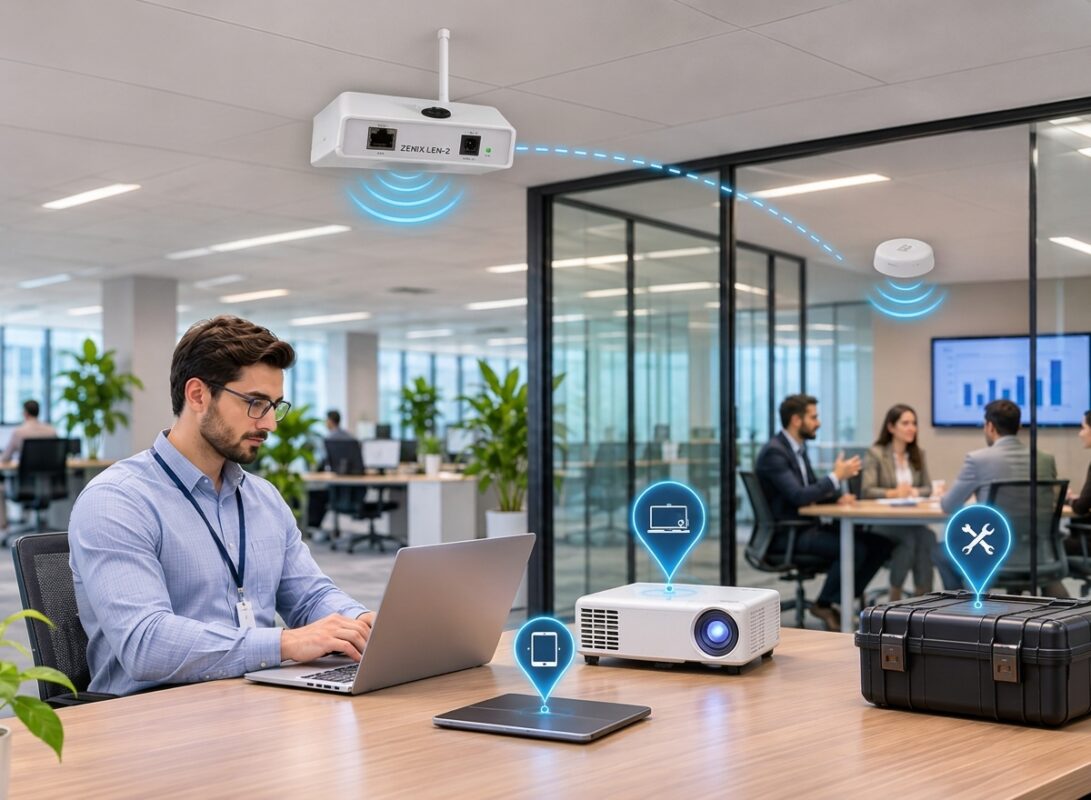
Laptops, mobile devices, presentation equipment and maintenance tools are shared across floors and teams. Items are easily misplaced or taken out of designated areas. Staff lose time searching, and organizations end up buying replacements for lost items or extra units they do not need.
How Does RTLS Solve This
A small BLE asset tag is attached to each shared item. BLE gateways and BiLink anchors detect the tag, and the RTLS platform shows the item’s current room or zone on the floor map. If an asset leaves its designated area, the platform sends an alert. Location history and heat maps show which assets are used and which sit idle, and the data can go to a partner asset management system.
Business Impacts
- Less time searching for shared equipment
- Reduced loss of portable assets
- Better utilization of existing equipment
- Fewer unnecessary purchases of replacement assets
Core RTLS System Components
ZENIX LEN-2
Indoor BLE RSSI Gateway
NODIX CEN-1
BiLink BLE Relay Anchor
PINIX TOW-1 Hybrid BLE RSSI & AoA Asset Tag
SOLIX APIs
Asset Management Platform from Partners
Indoor Wayfinding & Location-Based Notifications
The Challenge
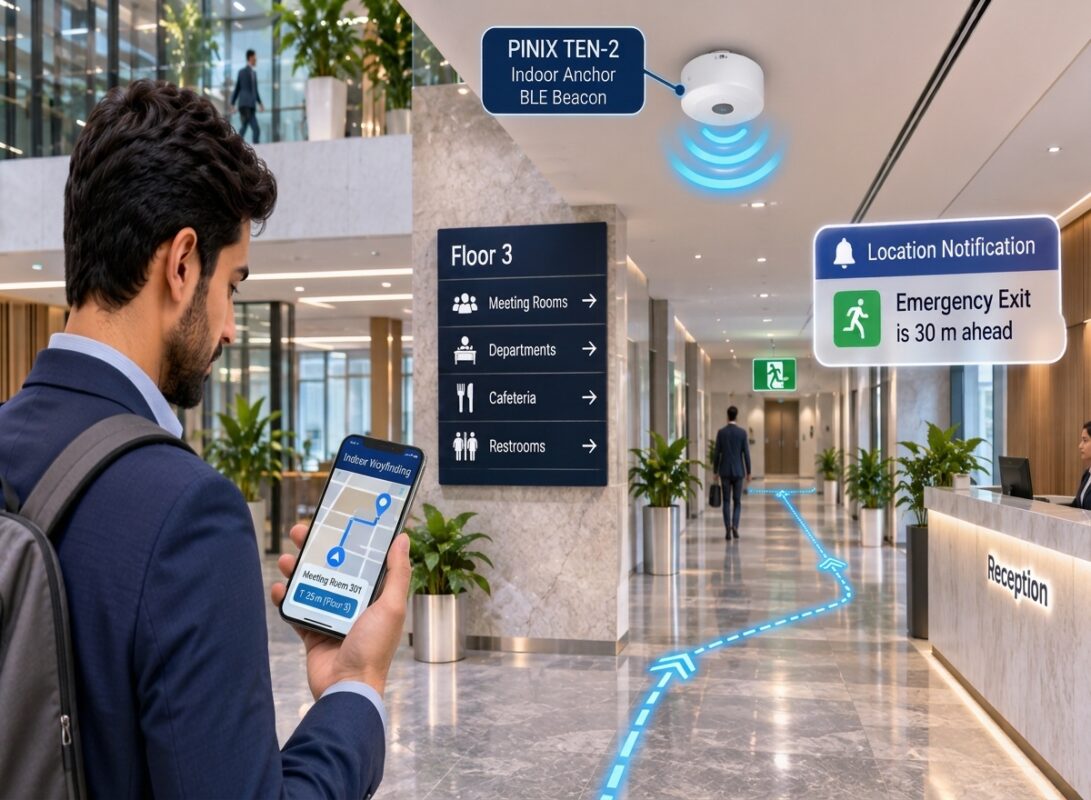
In large offices, campuses and multi-floor buildings, visitors often struggle to find meeting rooms, departments or facilities. They end up asking staff for directions or arriving late. Building operators also have no easy way to share location-specific information such as emergency exit guidance.
How Does RTLS Solve This
Battery-powered BLE anchor beacons are placed throughout the building. A mobile app built with the Sentrax POSIX SDK uses these beacon signals on the visitor’s smartphone to work out the user’s position, including which floor they are on. The app shows the user’s live position on the building map and guides them to their destination. It can also send notifications when the user reaches a defined point of interest, such as an emergency exit or a reception desk.
Core RTLS System Components


PINIX TEN-2 Indoor Anchor BLE Beacon
POSIX SDK (iOS & Android)
Mobile Application from Partners
Business Impacts
- Easier navigation for visitors and new staff
- Fewer direction requests to reception and staff
- Timely, location-specific information for building users
- Better visitor experience across large sites
How Does RTLS Support Smart City Operations?
In public venues and city infrastructure such as airports, museums, shopping malls, amusement parks and parking facilities, RTLS shows how people move through a space and where shared assets and vehicles are. BLE beacons, tags and indoor or outdoor gateways feed data to a high-level RTLS platform from Partners or to a POSIX-based mobile app. Operators use this to guide visitors, manage shared resources and plan services from real usage data.
Footfall & Dwell-Time Analytics in Public Venues
The Challenge
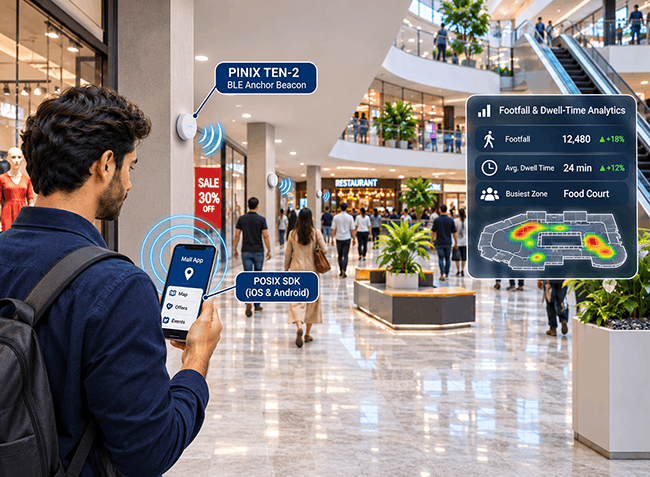
Operators of airports, museums and shopping malls need to know how visitors move through a venue and how long they stay in areas such as shops, restaurants or exhibits. Without this, decisions about layout, staffing and tenant placement rely on assumptions.
How Does RTLS Solve This
BLE anchor beacons are installed at key points of interest across the venue. When visitors use the venue’s mobile app built on the POSIX SDK, their position relative to these points is recorded. The RTLS platform or a partner analytics platform then calculates footfall, dwell time and movement patterns per area. The same app can send location-based information or offers when a visitor reaches a specific zone.
Business Impacts
- Clear footfall and dwell-time data for each area
- Better layout and tenant planning decisions
- Staffing matched to actual visitor flow
- More relevant visitor communication by location
Core RTLS System Components

PINIX TEN-2 Indoor Anchor BLE Beacon
POSIX SDK (iOS & Android)
High-Level RTLS Platform from Partners
Solix RTLS and IoT Management APIs
Airport Trolley Tracking
The Challenge
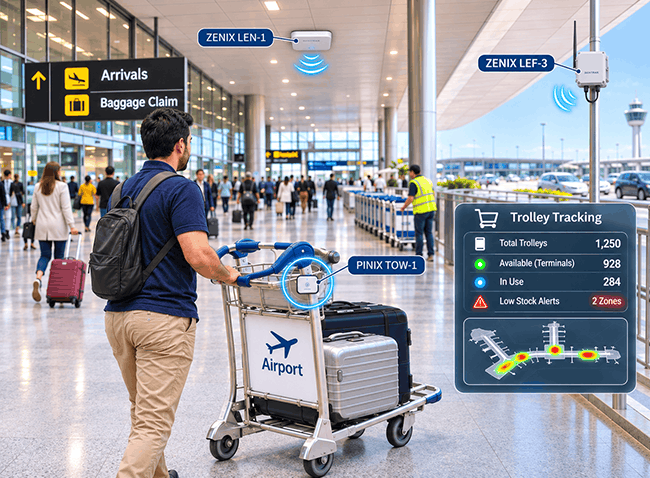
Airport luggage trolleys are left scattered across terminals, parking lots and pick-up areas. Some go unused for long periods while other zones run short. Staff spend time collecting and moving trolleys without knowing where they are needed.
How Does RTLS Solve This
Each trolley carries a rugged BLE asset tag. Indoor gateways in the terminals and outdoor gateways in parking lots and curbside areas detect the tags, and the RTLS platform shows how many trolleys are in each zone. Geofence alerts tell operations teams when a zone is running low or when trolleys leave the airport area. Usage history shows where trolleys tend to build up.
Core RTLS System Components
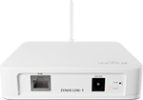
ZENIX LEN-1 Indoor BLE RSSI Gateway
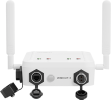
ZENIX LEF-3 Outdoor BLE RSSI Gateway
PINIX TOW-1 Hybrid BLE RSSI & AoA Asset Tag
High-Level RTLS Platform from Partners
Solix RTLS and IoT Management APIs
Business Impacts
- Trolleys available where passengers need them
- Less time collecting and moving trolleys
- Fewer trolleys leaving the airport area
- Better planning of trolley fleet size
Parking Guidance & Duration Tracking
The Challenge
In large public and multi-level parking garages, drivers lose time finding free spaces and often forget where they parked. For operators, tracking how long vehicles stay and handling billing often involves manual checks and paperwork.
How Does RTLS Solve This
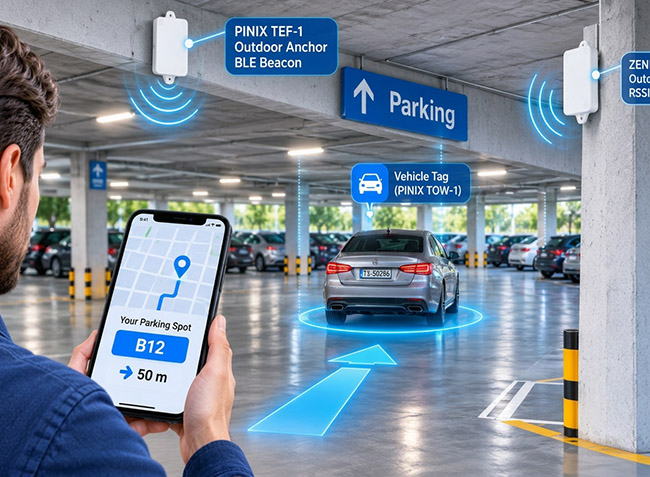
BLE anchor beacons in the parking facility allow a POSIX-based mobile app to save the driver’s parking spot and guide them back to it. The app can also connect to a partner parking management system for spot booking. For vehicles fitted with a BLE asset tag, indoor or outdoor gateways detect entry and exit at each zone. The RTLS platform records the timestamps, and the parking management system uses them to calculate parking duration and billing.
Business Impacts
- Less time spent finding spaces and parked vehicles
- Automated duration records for billing and enforcement
- Less manual paperwork for parking operators
- Better use of available parking capacity
Core RTLS System Components
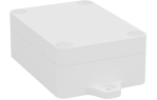

PINIX TEF-1 Outdoor Anchor BLE Beacon
POSIX SDK (iOS & Android)
ZENIX LEF-3 Outdoor BLE RSSI Gateway
PINIX TOW-1 Hybrid BLE RSSI & AoA Asset Tag (vehicle tag)
SOLIX APIs
Transform Your Smart City Operations with Sentrax RTLS Systems
Fill out the form below to request a demo, consultation, or evaluation kit.