


Blog
Beyond Asset Tracking: How BLE RTLS Helps Healthcare Organizations Address Today’s Operational Challenges

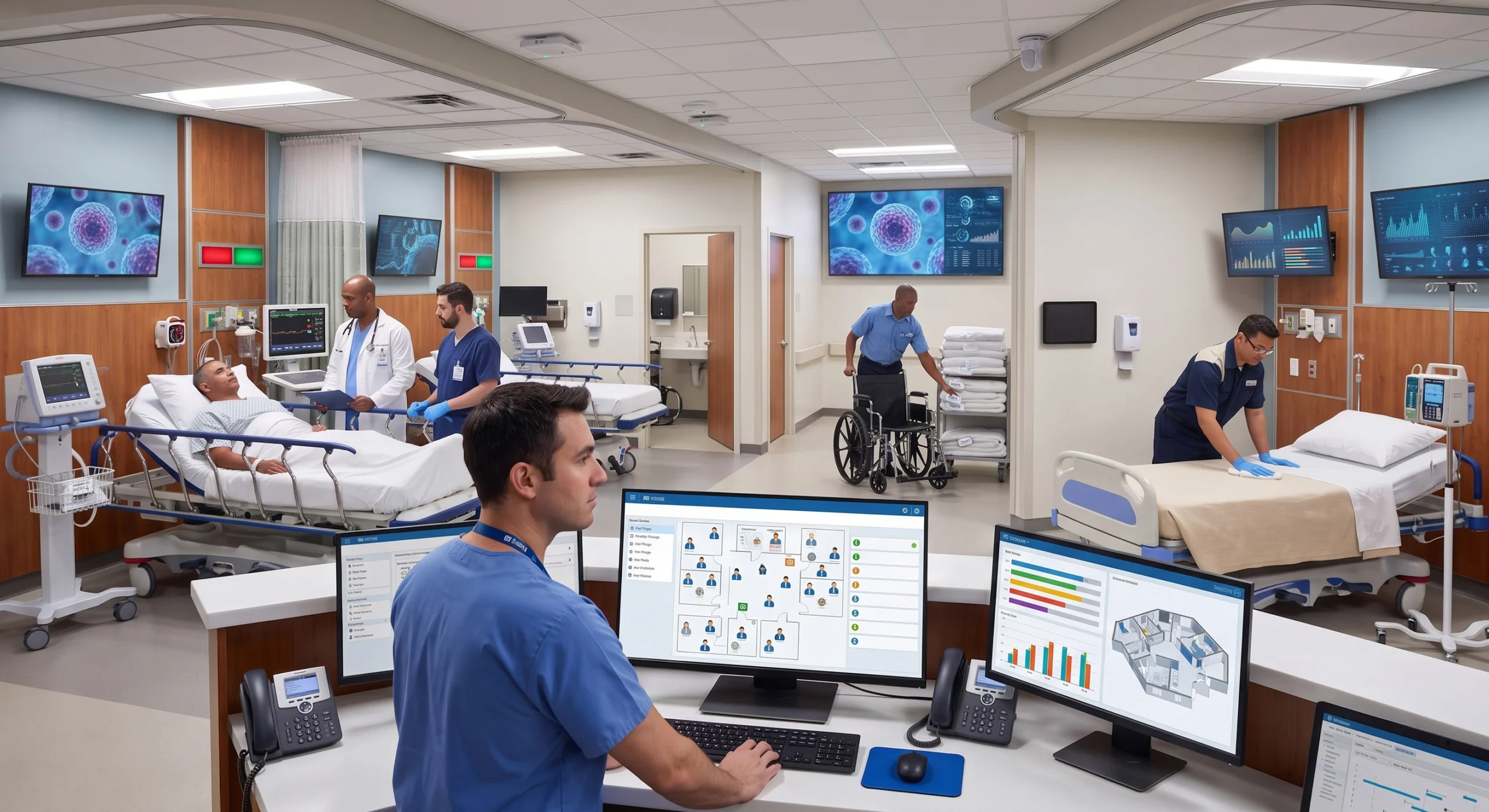
Healthcare providers around the world are under pressure to deliver safer, faster, and more efficient care.
Across Europe, the United States, the GCC, Asia-Pacific, and other regions, hospitals face many of the same operational challenges:
- Shortages of skilled healthcare workers
- Rising operating and labor costs
- Increasing patient demand
- Complex medical equipment inventories
- Pressure to improve patient safety
- Delays in patient flow and room turnover
- Greater expectations for digital integration
- The need to protect staff, patients, and sensitive data
The scale and structure of these challenges vary by market. European healthcare systems may focus heavily on workforce capacity and efficient use of public resources. US providers often face cost, reimbursement, compliance, and capacity pressures. GCC countries are investing rapidly in smart hospitals and large-scale healthcare transformation. Emerging healthcare markets may prioritize scalable infrastructure and efficient resource allocation.
In each case, healthcare organizations need better operational visibility.
Hospitals may know which equipment they own and which employees are scheduled, but they do not always know:
- Where a critical device is located
- Whether equipment is available or in use
- Whether a room is ready for the next patient
- Whether a device has been cleaned or maintained
- Where assistance is needed during an emergency
- How patients, staff, and assets move through clinical workflows
Bluetooth Low Energy Real-Time Location Systems can provide the location and movement intelligence needed to close these information gaps.
Rather than simply displaying an asset on a map, BLE RTLS can connect real-time location events with clinical, safety, maintenance, and operational processes.
Reducing Avoidable Work for Healthcare Staff
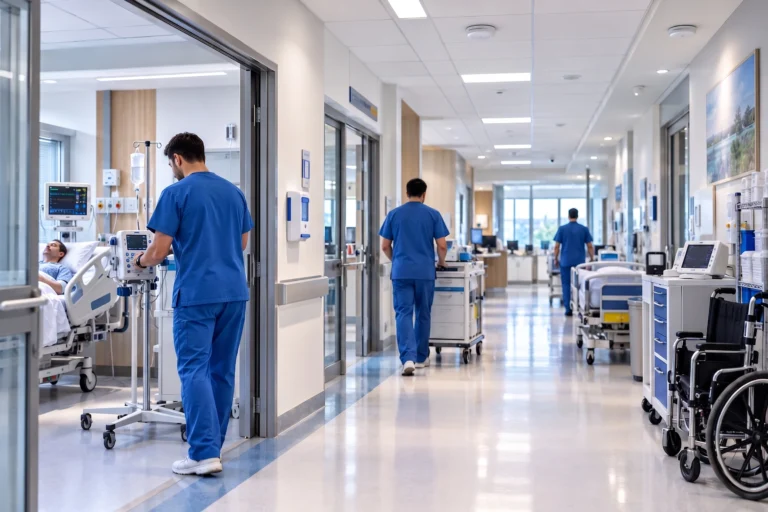
The World Health Organization projects a global shortage of approximately 11 million health workers by 2030.
This makes effective use of existing staff a priority for healthcare systems in both developed and developing markets.
Healthcare professionals regularly lose time searching for equipment, contacting other departments, confirming room availability, and locating colleagues. Across a large hospital or healthcare network, these small delays can create a significant operational burden.
BLE tags attached to wheelchairs, infusion pumps, portable monitors, beds, and other mobile assets allow authorized staff to view their current department, zone, room, or precise position, depending on the technology used.
This can help providers:
- Reduce equipment search time
- Locate the nearest available resource
- Improve coordination between departments
- Limit unnecessary equipment rentals and purchases
- Return equipment to service faster
- Give clinical staff more time for patient care
The benefit applies across different healthcare models. A public hospital may use RTLS to maximize limited resources, while a private healthcare network may use it to improve service quality, utilization, and cost control.
Connecting Asset Location With Readiness
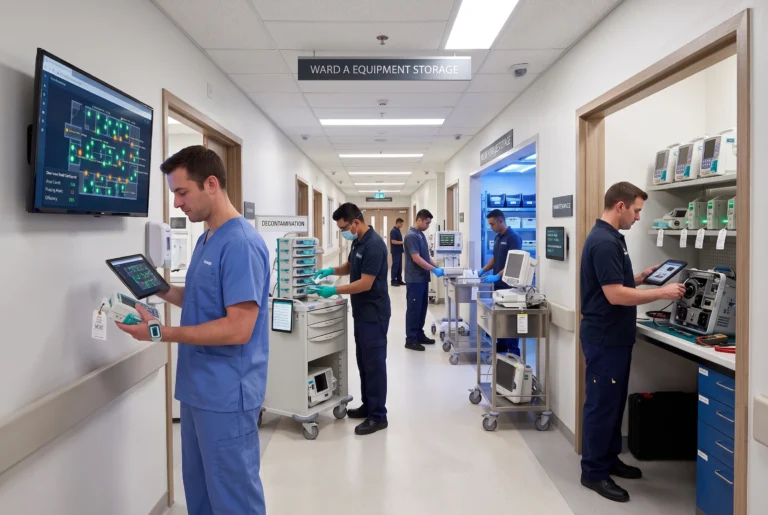
Finding a medical device does not necessarily mean it is ready to use.
Equipment may be:
- Awaiting cleaning
- Under maintenance
- Due for inspection
- Subject to a recall
- Reserved for another department
- Stored in an unauthorized area
BLE RTLS can connect equipment movement with operational status.
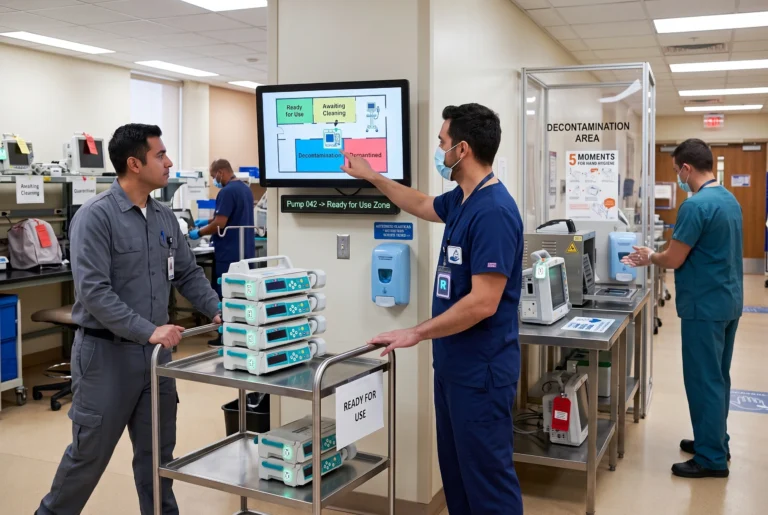
For example, when a tagged device enters a decontamination area, the system can create a cleaning event. When the process is completed and the device returns to approved storage, its status can be updated to available.
Similar rules can identify when:
- Recalled equipment remains in a clinical area
- A device due for service has not reached maintenance
- Equipment leaves an authorized boundary
- An asset remains unused for an extended period
- One department retains more devices than it regularly uses
This allows healthcare organizations to understand not only where equipment is, but also whether it is safe, available, and ready for use.
It can also support regulatory, quality, and maintenance requirements that differ between markets while relying on a common location-intelligence foundation.
Improving Bed Turnover and Patient Flow
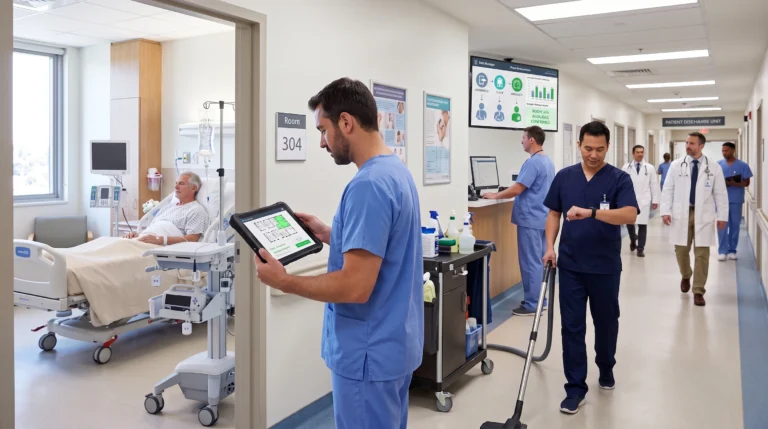
Patient-flow delays affect hospitals worldwide.
They can contribute to emergency-department congestion, postponed admissions, slower transfers, longer waiting times, and poor use of available capacity.
A patient may be ready to leave, but several activities must occur before the room can accept another patient. Transport may need to arrive, equipment must be removed, environmental services must clean the room, and bed-management teams must confirm that the space is available.
BLE RTLS can generate workflow events as patients, staff, and equipment move between defined areas.
A location-aware process may work as follows:
- A patient wearable leaves the room following discharge or transfer.
- A cleaning task is sent to environmental services.
- The arrival and departure of the cleaning team update the room’s status.
- Tagged equipment is removed, cleaned, or replaced.
- The bed-management platform receives confirmation that the room is available.
Through Solix RTLS Platform, these events can connect with hospital information, bed-management, maintenance, and task-management systems.
Location data can also reveal how long patients spend in registration, diagnostics, treatment, recovery, transport, and discharge. This enables healthcare leaders to identify specific bottlenecks rather than treating waiting time as one general problem.
Supporting Infection-Control Traceability
Healthcare-associated infections are a global patient-safety concern.
The World Health Organization reports that approximately 7 out of every 100 patients in acute-care hospitals in high-income countries and 15 out of every 100 patients in low- and middle-income countries acquire at least one healthcare-associated infection during their hospital stay.
RTLS can improve operational traceability. Authorized teams may use historical location data to investigate:
- Which tagged devices entered an isolation room
- Whether equipment moved elsewhere before cleaning
- How long an asset remained in a high-risk area
- Which reusable devices passed through decontamination
- Which tagged resources were present in an affected zone
Hospitals can also define equipment-status zones such as:
- Ready for use
- Awaiting cleaning
- Under decontamination
- Quarantined
- Under inspection
Movement between these areas can automatically update equipment status or generate alerts when a required process has not been completed.
This can support infection-control programs in large academic hospitals, regional medical centers, private healthcare groups, long-term care facilities, and other clinical environments.
Strengthening Staff and Patient Safety
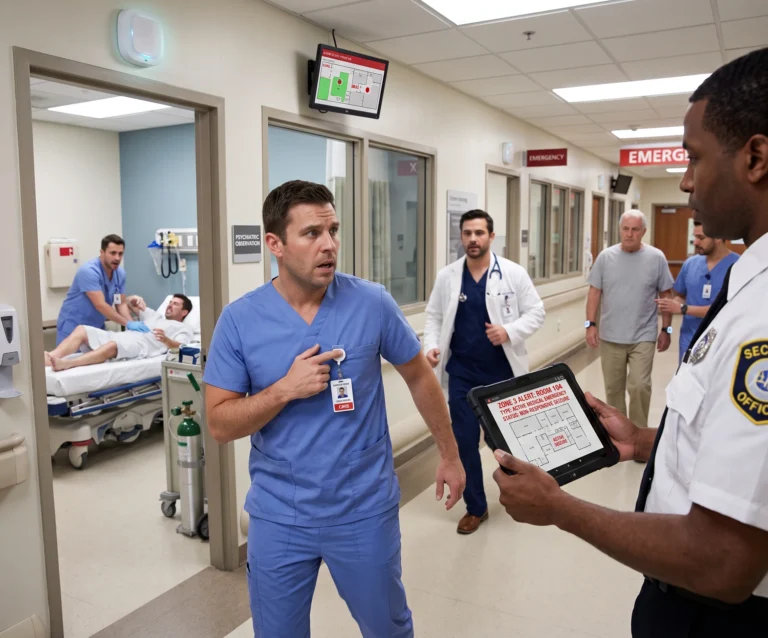
Healthcare workers may face violence, lone-working risks, psychiatric emergencies, security incidents, and other high-pressure situations.
BLE-enabled staff badges can include an SOS or duress button. When activated, an alert can include the employee’s room or zone, helping response teams understand where assistance is required.
This can support:
- Staff duress response
- Lone-worker protection
- Security incidents
- Emergency and psychiatric department safety
- Coordination of the nearest responder
BLE wearables can also support patient-safety applications such as wandering prevention, movement beyond authorized zones, and protection of infants or vulnerable patients.
These applications should be implemented with appropriate privacy, cybersecurity, consent, access-control, and data-retention policies.
The specific requirements may differ under frameworks such as GDPR in Europe, HIPAA-related controls in the US, and national healthcare-data regulations in GCC and other markets. The underlying principle remains the same: collect only the information required for a defined safety or operational purpose.
Managing Assets Across Multiple Facilities
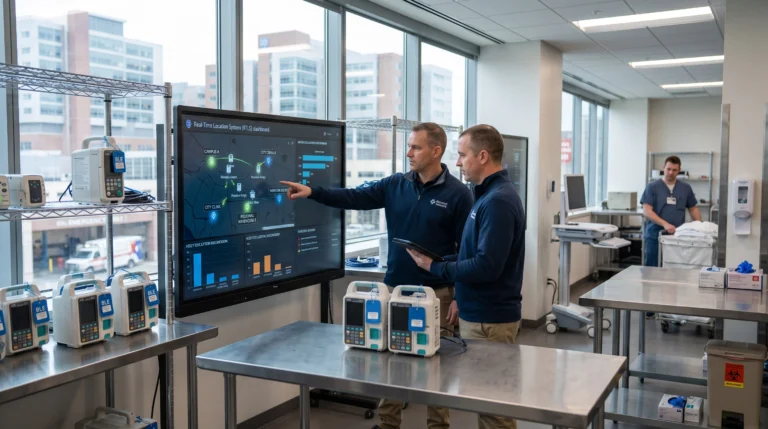
Many healthcare providers now operate across more than one building, campus, clinic, or city.
This creates additional challenges:
- Equipment may move between facilities
- Inventory information may not be consistent
- Different sites may use different operational processes
- Maintenance teams may lack a unified asset view
- Purchasing decisions may be made without accurate utilization data
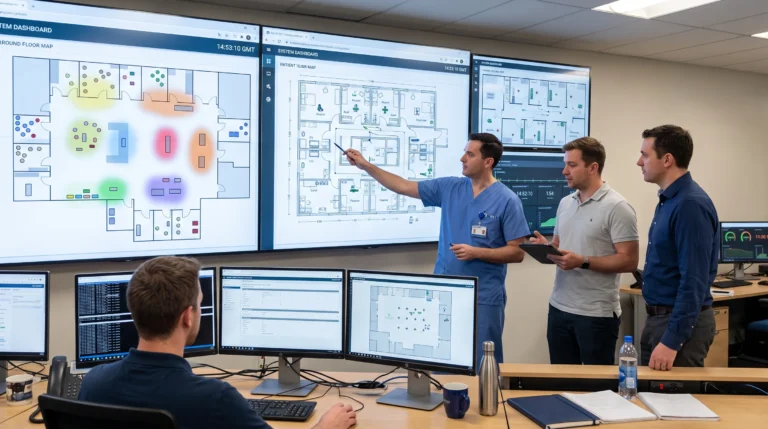
A scalable BLE RTLS platform can give healthcare networks a common view of tagged resources across multiple locations.
Healthcare leaders can analyze:
- Which sites use equipment most frequently
- Where devices remain idle
- Whether assets are being transferred efficiently
- Which facilities experience repeated shortages
- Whether inventory can be rebalanced before new purchases are approved
This is particularly relevant to integrated health systems in the US, cross-border private hospital groups, national healthcare programs, and rapidly expanding healthcare networks in the GCC and Asia.
Choosing the Right BLE RTLS Technology
Not every healthcare environment requires the same level of accuracy.
BLE RSSI can provide cost-efficient proximity or zone-level visibility across large areas. It may be appropriate for general asset tracking, department-level monitoring, and entry or exit detection.
Sentrax BiLink can provide room-level visibility where healthcare organizations need to determine which room contains a patient, staff member, or asset. Its bidirectional BLE architecture can help reduce hallway bleed and improve detection across rooms and transitional spaces.
BLE Angle of Arrival can support more precise positioning where the safety or business requirement justifies greater accuracy, such as high-value equipment tracking or selected staff-safety applications.
A hybrid BLE RTLS deployment can combine these approaches.
For example, a hospital might use:
- RSSI across general areas
- BiLink in patient rooms and clinical departments
- AoA in high-value or high-risk locations
This allows providers to align cost, infrastructure, and accuracy with the requirements of each use case.
From Location Tracking to Workflow Automation
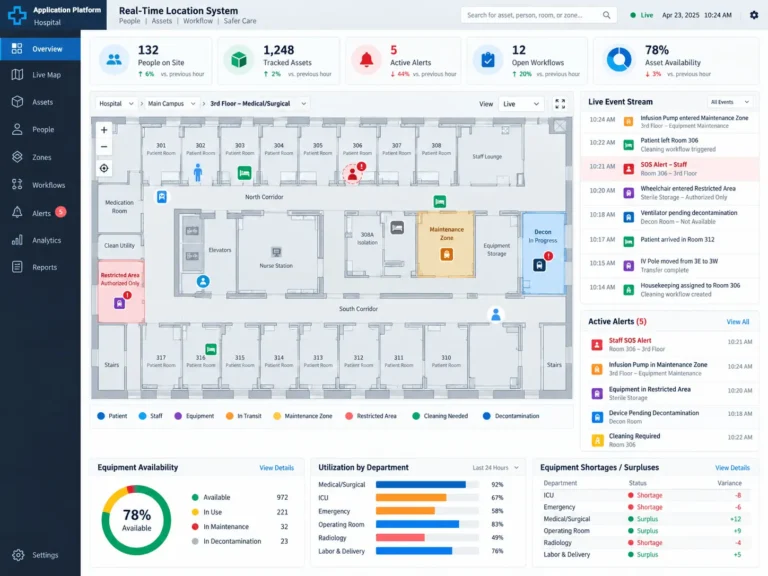
The greatest value of RTLS comes when location information triggers an action.
Examples include:
- A device entering a maintenance zone creates a service event.
- A patient leaving a room initiates a cleaning workflow.
- A staff SOS alert includes the location where support is required.
- Equipment entering a restricted area generates a notification.
- A device that has not completed decontamination remains unavailable.
- Utilization data reveals equipment surpluses and shortages between departments or facilities.
Sentrax supports these applications through BLE tags, badges, wearables, locators, BiLink room-level infrastructure, BLE AoA, hybrid deployments, and the application platform.
Conclusion
Healthcare providers in Europe, the US, the GCC, and other global markets operate under different regulatory, financial, and organizational conditions.
However, many of their operational challenges are similar.
They need to make better use of limited staff, improve equipment availability, reduce patient-flow delays, strengthen safety, and manage increasingly complex facilities.
BLE RTLS can help healthcare organizations:
- Reduce avoidable staff workload
- Improve equipment availability and utilization
- Connect asset location with cleaning and maintenance status
- Accelerate room turnover
- Identify patient-flow bottlenecks
- Strengthen infection-control traceability
- Improve staff and patient safety
- Standardize visibility across multiple facilities
- Automate operational events through existing systems
Healthcare organizations do not simply need more data. They need reliable, real-time information that supports better decisions and faster action.
By selecting the appropriate combination of RSSI, BiLink, AoA, and hybrid BLE technologies, healthcare providers can build a scalable location-intelligence foundation that responds to both local requirements and shared global healthcare challenges.
See How BLE RTLS Can Improve Healthcare Operations
Explore how Sentrax’s BLE-based RTLS solutions can support asset visibility, room-level tracking, patient flow, staff safety, and workflow automation.