


Blog
How BiLink Simplifies Room-Level RTLS for Healthcare

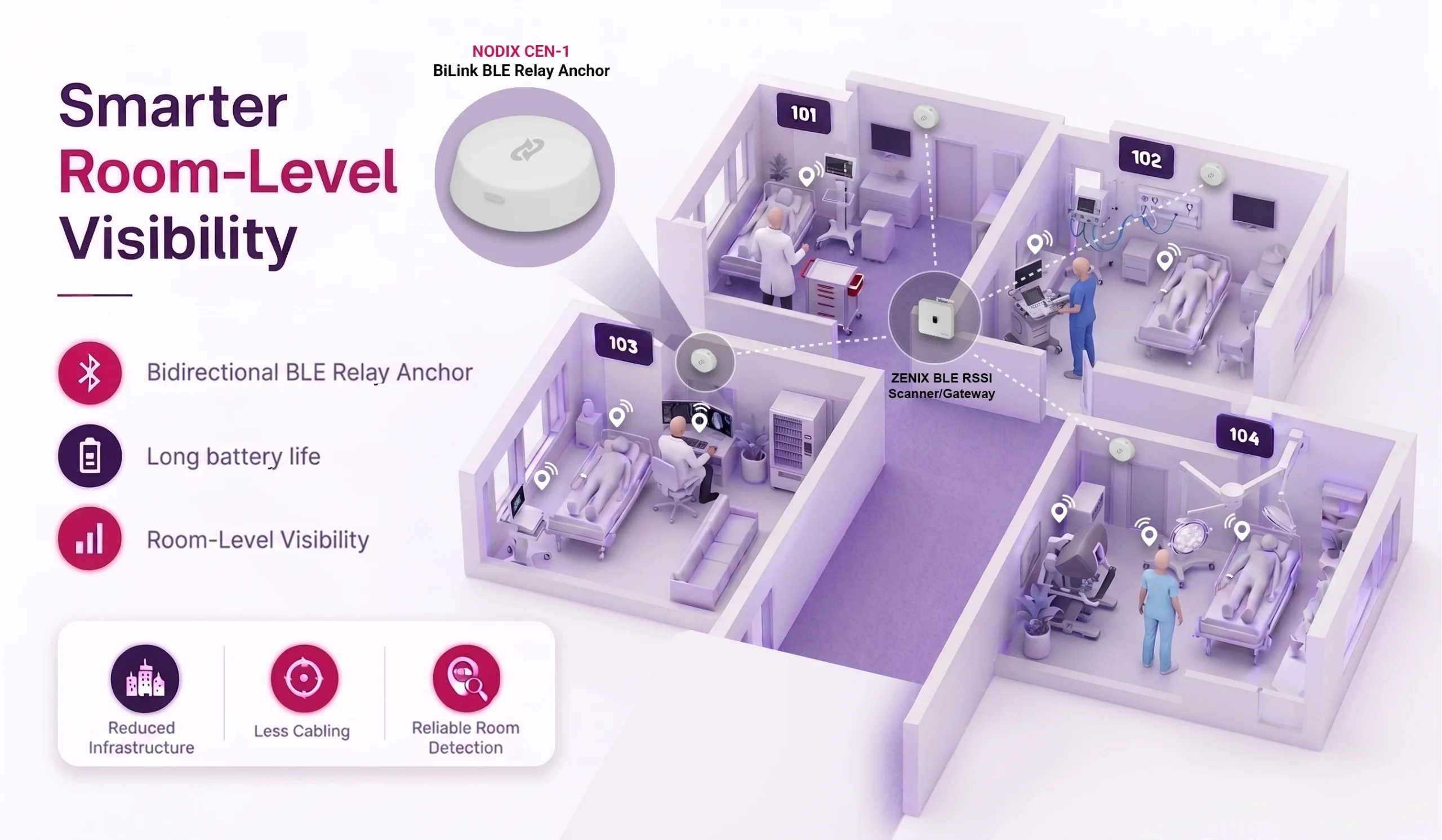
Healthcare organisations worldwide are under pressure to control rising operational costs while improving patient safety, staff productivity, and the availability of medical equipment.
Real-Time Location Systems can help hospitals gain better visibility of patients, employees, and mobile assets. However, deploying room-level tracking across a hospital can introduce its own challenges.
Depending on the deployment approach, RTLS systems may require scanners, gateways, power connections, network access, and cabling across many rooms. In facilities containing more patient rooms, consultation spaces, storage areas, treatment bays, and connecting corridors, this can increase:
- Hardware and installation costs
- Infrastructure complexity
- Deployment time
- Maintenance requirements
Sentrax BiLink addresses these challenges through a bidirectional, relay-based architecture operating under BLE RSSI technology.
It is designed to provide reliable room- and zone-level visibility, particularly in smaller rooms, adjacent spaces, entry points, and transitional areas, without requiring dense gateway infrastructure throughout the facility.
What Is BiLink?
BiLink is a specialised BLE RSSI proximity-tracking system designed to improve room-level detection in complex indoor environments.
- At the centre of the system is the battery-powered NODIX CEN-1 BiLink relay anchor. Each anchor operates as both:
- A scanner that detects nearby BLE tags
- A broadcaster that relays room- and zone-identified presence data to the wider BiLink infrastructure
When a patient wearable, staff badge, or asset tag is detected, the NODIX CEN-1 associates the event with its configured room or zone and wirelessly relays the data to a nearby ZENIX gateway. SOLIX RTLS Platform then processes the validated location event for visualisation, alerts, and system integrations.
This local room scan and bidirectional relay communication support reliable zone detection, clearer room boundaries, and smoother handover between adjoining spaces.
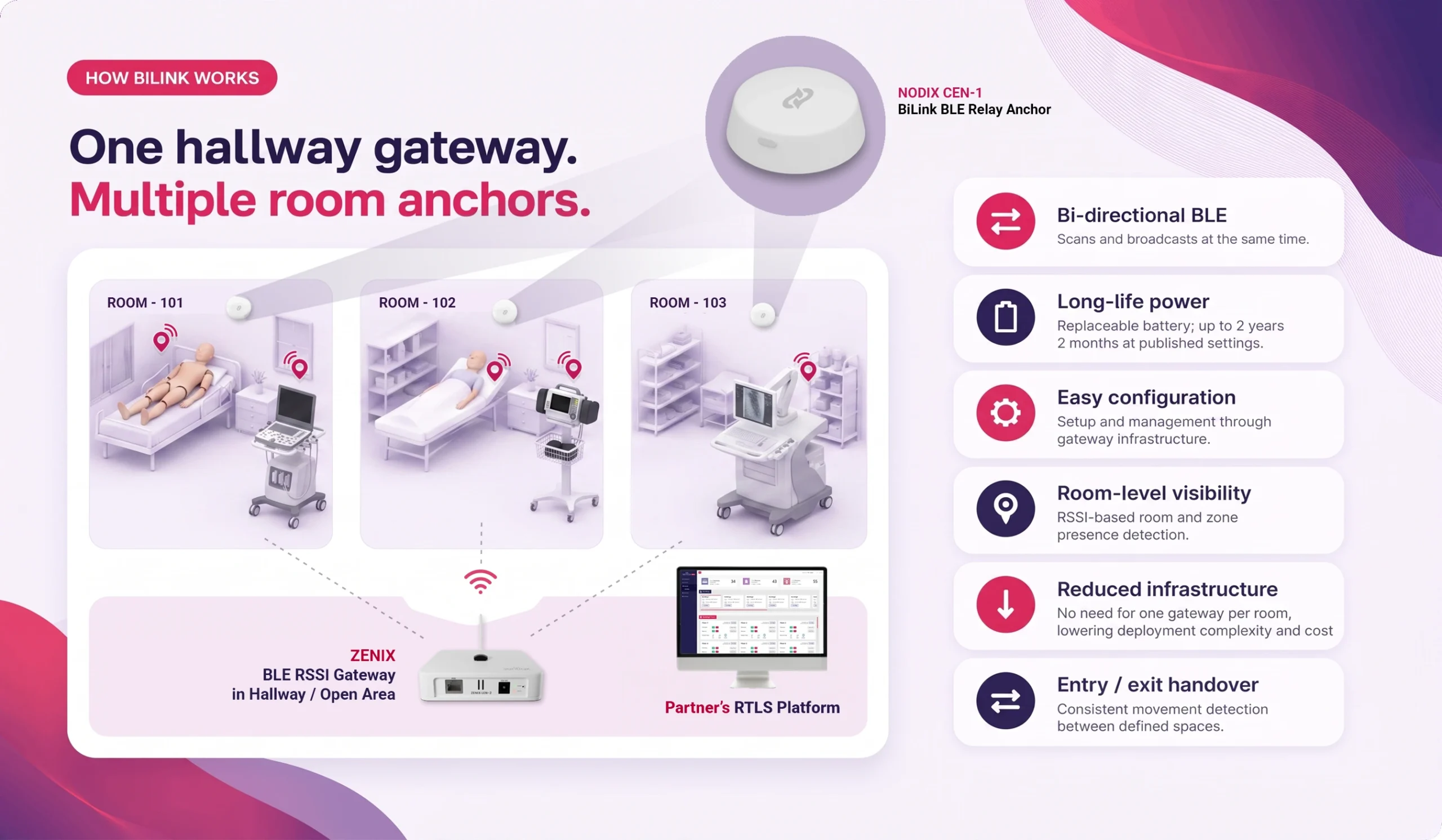
Supporting Smaller Rooms With Less Infrastructure
Hospitals often contain many relatively small spaces where room-level visibility is valuable but installing a dedicated gateway in every room may not be practical.
Examples include:
- Patient rooms
- Consultation rooms
- Examination spaces
- Treatment cubicles
- Equipment stores
- Isolation rooms
- Utility rooms
- Small clinical offices
Placed inside rooms and at entry and exit points, NODIX anchors create a local detection layer. They relay room-identified tag data to central ZENIX gateways positioned in corridors or open areas, extending visibility into small rooms, blind spots, and transitional spaces.
As a result, healthcare organisations do not necessarily need to install a dedicated scanner or gateway in every individual room. Sentrax states that BiLink is designed to minimise infrastructure requirements and reduce dependence on dense gateway deployments.
This can help healthcare providers reduce:
- The number of conventional gateways required
- Cabling and electrical work
- Network connection requirements
- Installation labour
- Hardware maintenance
- Overall deployment and operational costs
Actual infrastructure and performance will depend on room geometry, wall materials, the local radio environment, tag placement, calibrated thresholds, and the required update rate.
Faster, Plug-and-Play Deployment
Installing technology in an active healthcare environment can be difficult.
Clinical areas may have limited access, infection-prevention requirements, and little tolerance for drilling, electrical work, network changes, or prolonged disruption. Installing powered, IP-connected devices in every room can therefore delay an RTLS project.
The NODIX CEN-1 is battery-powered, uses a replaceable battery, and supports simple mounting with adhesive or screws. It can be installed without adding power or network cabling in every room, helping healthcare organisations deploy room-level tracking more quickly and with less disruption.
This plug-and-play approach can support:
- Faster installation
- Easier placement in existing buildings
- Phased expansion by department
- Deployment in temporary clinical areas
- Reconfiguration when room layouts change
- Scalable addition of anchors and tags
Healthcare organisations can begin with one ward or operational use case, configure anchors through the Sentrax gateway infrastructure, and expand the system as tracking requirements grow.
Key Features and Practical Benefits
For room-level healthcare deployments, the NODIX CEN-1 combines proximity detection, relay communication, flexible installation, and long-life battery operation in one compact anchor.
- Bi-directional BLE operation — Simultaneous scanning and broadcasting allow one anchor to perform two jobs, reducing the hardware required inside each room.
- Long-lasting power — The replaceable ER14505 x2, 4800 mAh battery supports up to 2 years 2 months of operation at the published 5000 ms advertising and scanning intervals.
- Easy configuration — Anchors can be configured and managed through the Sentrax gateway infrastructure, supporting faster rollout with less room-level IT work.
- Room-level visibility — Calibrated RSSI proximity detection identifies the room or defined zone in which a tagged asset or person is present.
- Reduced infrastructure — Multiple room anchors can relay data to fewer central gateways. Sentrax publishes hardware cost per room of up to 60% less than traditional gateway-only setups.
- Zone entry and exit detection — Continuous room and zone events support more consistent handover, inventory movement, and access-monitoring workflows.
Published battery-life, accuracy, and cost outcomes depend on device settings, room geometry, radio conditions, tag placement, and the final deployment design.
Medical Equipment Tracking
Medical equipment frequently moves between patient rooms, treatment areas, storage spaces, and maintenance departments.
When staff cannot find an infusion pump, wheelchair, monitor, hospital bed, or portable medical device, they may spend valuable time searching several rooms or contacting other departments.
BLE tags attached to equipment allow BiLink to identify the room or zone in which an asset is present.
This can help hospitals:
- Find equipment more quickly
- Reduce manual search time
- Improve asset availability
- Identify equipment stored in the wrong room
- Reduce unnecessary rentals or purchases
- Improve use of existing inventory
For many asset-tracking workflows, employees do not need an exact coordinate. Knowing which room contains the equipment is often enough to retrieve it efficiently.
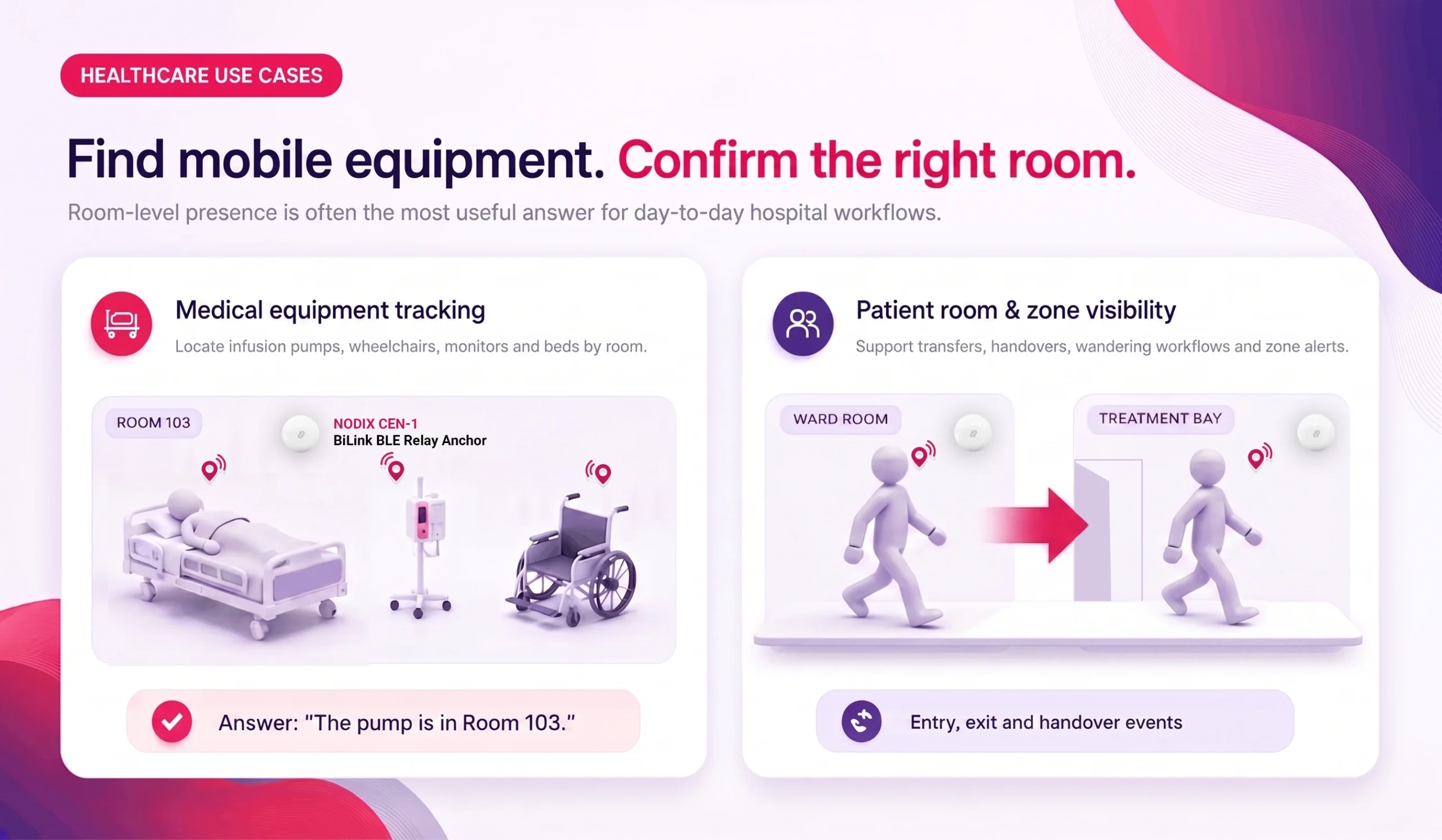
Healthcare use cases: locate mobile equipment by room and support patient room-to-room handover events.
Current Challenges in Complex Hospital Layouts
Hospitals combine small rooms, adjoining bays, corridors, storage areas, and restricted spaces. Walls, doors, equipment, varying room sizes, and constant movement can weaken BLE signals and create blind spots or hallway bleed. Active clinical areas also limit cabling, power work, new IP-connected devices, drilling, and prolonged installation.
Room-assigned NODIX CEN-1 anchors scan local tags, associate detections with a configured room or zone, and relay the data wirelessly to a ZENIX gateway. Calibrated thresholds and bidirectional communication support clearer room-level presence and smoother entry/exit handover without a gateway in every room.
This can help healthcare organisations:
- Strengthen room- and zone-level presence detection across small, adjoining, or enclosed spaces
- Reduce blind spots and hallway bleed at room boundaries
- Avoid adding an IP-addressable gateway, power, and network cabling in every room
- Place or reposition anchors as wards, room layouts, and workflows change
- Expand ward by ward or use case by use case with less disruption
Patient Room and Zone Visibility
BLE-enabled patient wearables can help authorised teams understand which room or defined area contains a patient.
![Hospital room with patient bed and wall-mounted beacon and BLE scanner for patient tracking (labels: NODIX CEN-1, ZENIX BLE RSSI). On the right, a monitor shows a 'Partner's Platform' patient visibility dashboard with room 305 and floor plan.]](https://sentrax.com/wp-content/uploads/2026/08/4-1-scaled.webp)
Dignified monitoring: ensuring patient safety without constant manual checks.
BiLink can support:
- Patient transfer coordination
- Movement between departments
- Faster handovers
- Wandering-prevention workflows
- Restricted-zone alerts
- Monitoring of vulnerable patients
- Entry and exit detection
BiLink provides the location event, while an integrated healthcare platform can manage the wider clinical or operational workflow.
Staff Coordination and Safety
Healthcare staff move continuously between rooms and departments.
BLE badges can help authorised teams confirm whether a staff member has reached a patient room and identify who is present in a nearby room or zone.
Badges may also include an SOS function. When an emergency alert is activated, BiLink can provide room or zone context, helping response teams understand where assistance is required.
Applications may include:
- Staff duress response
- Lone-worker protection
- Emergency-department safety
- Psychiatric-unit incidents
- Security coordination
- Identification of nearby responders
Staff-location applications should be supported by clear privacy policies, role-based access, and appropriate data-retention rules.
Entry, Exit, and Sensitive-Area Monitoring
Hospitals contain areas where the movement of patients, employees, or equipment must be monitored.
These may include:
- Isolation areas
- Infant-care units
- Equipment stores
- Operating departments
- Restricted clinical spaces
- Controlled entrances and exits
Through SOLIX RTLS Platform, BiLink room and zone events can generate real-time alerts when a tagged person or asset enters or leaves a defined area.
Its relay architecture and continuous signal validation are designed to support stable handover between rooms and reduce missed events in corridors and transitional areas.
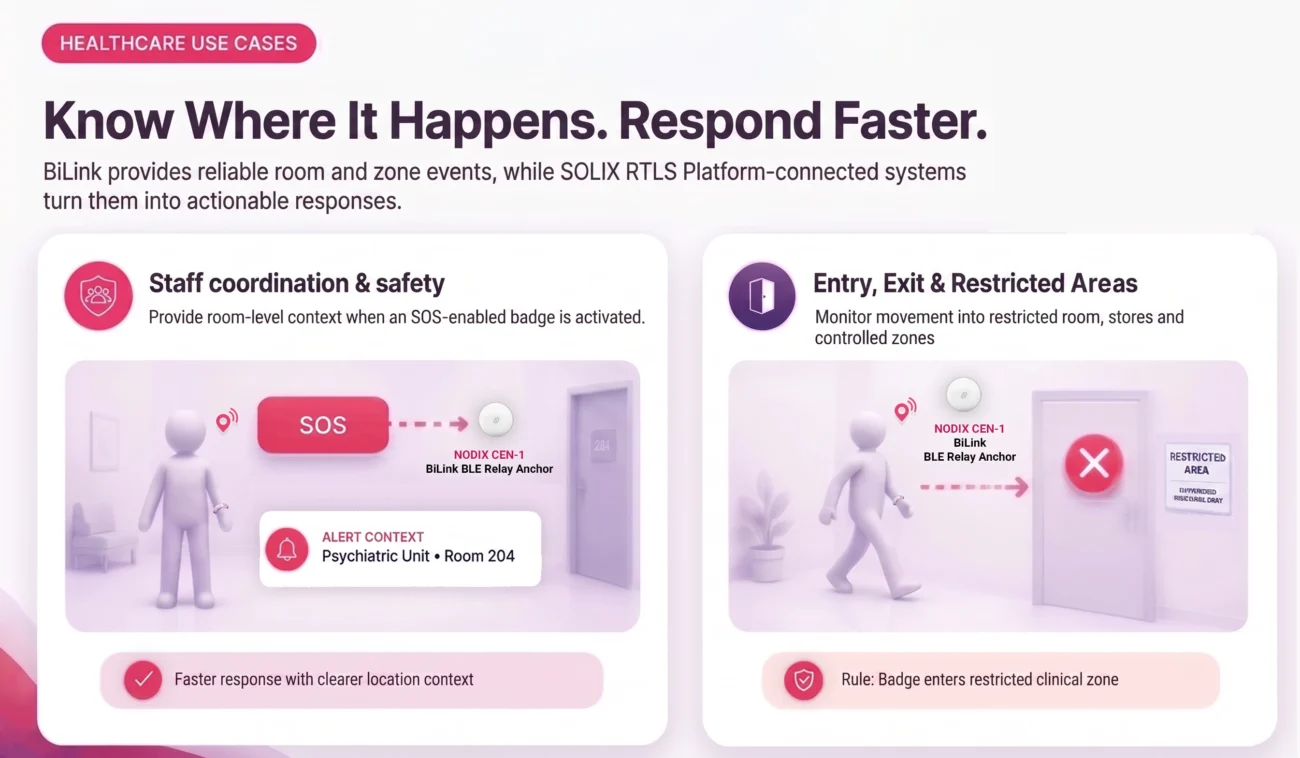
Healthcare use cases: add room context to staff-safety alerts and sensitive-area entry or exit events.
Room Turnover and Patient Flow
Room-level location events can also support operational workflows.
For example, when a patient wearable leaves a room, the event can be passed to a bed-management or task-management system. This may initiate a cleaning request or update the room’s status.
BiLink data can help healthcare organisations understand:
- When a patient entered or left a room
- How long a patient remained in a treatment area
- When staff arrived
- Whether required equipment was present
- When a room became available
- Whether the cleaning team reached the room
These insights can help identify delays and improve coordination between discharge, cleaning, and the next admission.
Equipment Status and Maintenance Workflows
Knowing where equipment is located does not necessarily mean it is ready for use.
A device may be awaiting cleaning, undergoing maintenance, due for inspection, or placed in quarantine.
Healthcare organisations can define operational zones such as:
- Ready for use
- Awaiting cleaning
- Under decontamination
- Under maintenance
- Quarantined
- Approved storage
When tagged equipment moves between these zones, BiLink can send a location event to the Sentrax Solix RTLS platform.
This helps staff understand both where the equipment is and its current operational status.
Integration With Healthcare Systems
BiLink integrates with the SOLIX RTLS platform, where validated room and zone events can be managed, visualised, and used to generate alerts.
APIs and middleware can also connect BiLink location events with third-party systems, including healthcare, security, building-management, and operational platforms.
Examples include:
- A patient leaving a room initiates a cleaning task.
- Equipment entering maintenance updates its status.
- A staff SOS alert includes room information.
- A device leaving an approved area generates a notification.
- A patient entering a restricted zone triggers an alert.
- A bed-management platform receives a room-availability event.
This allows healthcare organisations to move beyond viewing locations and use real-time events to support automated workflows.
BiLink Within Sentrax’s BLE Technology Portfolio
BiLink should not be considered a separate alternative to BLE RSSI.
It is a specialised architecture operating under BLE RSSI technology, designed to improve room- and zone-level tracking through bidirectional relay anchor communication.
A healthcare deployment may therefore use:
- Standard BLE RSSI tracking for broad area or department-level visibility
- BiLink BLE RSSI tracking for smaller rooms and reliable room-level asset and person visibility, and entry/exit detection
- BLE Angle of Arrival Tracking where more precise positioning is required
- Hybrid BLE RTLS where BLE RSSI, BiLink, and AoA capabilities are combined across different areas
BiLink can work alongside AoA-based tracking as part of a hybrid deployment, allowing healthcare organisations to match accuracy and infrastructure to each use case.
Conclusion
Healthcare organisations need better visibility of patients, staff, and medical equipment, but installing a dedicated gateway or scanner in every room can make RTLS deployments expensive and complex.
BiLink provides a streamlined room-level architecture under Sentrax’s BLE RSSI technology.
Through local room detection, bidirectional BLE communication with Nodix CEN-1 relay-based anchors, BiLink is designed to improve room-l andevel presence certainty across smaller rooms, adjoining spaces, entry points, and transitional areas while reducing the need for a gateway in every room.
Its battery-powered design, easy mounting, and plug-and-play deployment can help healthcare organisations:
- Install room-level RTLS more quickly
- Reduce wiring and infrastructure requirements
- Lower deployment and operational costs
- Expand tracking across multiple rooms
- Improve medical-equipment visibility
- Support patient and staff location workflows
- Monitor sensitive areas and strengthen staff-safety applications
- Improve room turnover, patient flow, and system integration
By combining simplified infrastructure with reliable BLE RSSI room-level visibility, BiLink can help healthcare providers create a more efficient, scalable, and responsive care environment.
Eliminate Blind Spots. Track with Confidence
Deploy the BiLink Proximity Tracking to achieve reliable room-level visibility without complexity, powered by intelligent relay anchors and seamless integration with SOLIX RTLS or any third-party RTLS Platform.