


Blog
How RTLS Improves Patient Safety and Staff Efficiency in Healthcare

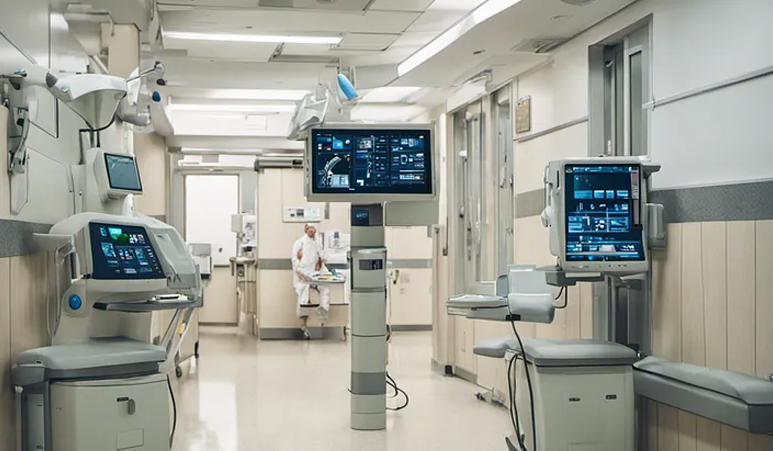
A real-time location system (RTLS) in healthcare uses small tags and ceiling- or wall-mounted locators to show where patients, staff and equipment are in real time. Hospitals use it to send location-specific alerts for falls, wandering and staff emergencies, and to find mobile equipment without searching. Bluetooth Low Energy (BLE) RTLS delivers room-level to sub-meter accuracy.
Key points
- RTLS turns “Where is…?” into a live map of patients, staff and assets.
- The biggest safety gain is faster response: every alert arrives with a precise location.
- The biggest efficiency gain is time: staff stop searching for equipment and colleagues.
- Match accuracy to the area: room level for most wards, sub-meter where bed- or bay-level precision matters.
What is RTLS in healthcare?
RTLS in healthcare is a network of tags, locators and software that continuously calculates the location of people and equipment inside a hospital or care facility. Unlike barcodes or passive RFID, which record a location only when an item is scanned or passes a reader, RTLS tags broadcast on their own, so location updates in real time.
A BLE RTLS has three parts:
- Tags. Wristbands for patients, badges for staff and rugged tags for equipment. Each broadcasts a Bluetooth Low Energy signal at a set interval. Many also carry sensors such as an accelerometer, a temperature sensor or a panic button.
- Locators (gateways). Ceiling- or wall-mounted receivers that pick up tag signals. RSSI gateways measure signal strength for room- or zone-level location. Angle of Arrival (AoA) locators measure the signal’s direction for sub-meter location.
- Software platform. Turns raw signals into positions on a floor map, applies rules such as geofences, alerts and escalations, and shares data with hospital systems through APIs.
[Image: b1-how-hospital-rtls-works | Alt: How a hospital RTLS works: tags broadcast, locators listen, SOLIX calculates location and staff act on alerts]
How does RTLS improve patient safety?
RTLS improves patient safety by cutting the time between an incident and the right person arriving. Tags detect events such as a fall, a patient leaving a safe zone or a pressed call button. The alert carries the exact room or bed, so staff go straight there instead of searching.
1. Fall detection with location-aware alerts
Falls are among the most common hospital incidents. The US Agency for Healthcare Research and Quality (AHRQ) estimates that 700,000 to 1,000,000 people fall in US hospitals each year. A tag with a motion sensor can flag a fall-like event and send an alert with the patient’s location to the nearest caregiver. The PINIX TOP-5 smart badge combines motion and fall detection with a panic button.
2. Wander and elopement prevention
Patients with dementia, delirium or psychiatric conditions are at risk of leaving safe areas. With RTLS, staff draw virtual boundaries (geofences) around exits, stairwells and lifts. If a patient wearing a tamper-proof bracelet such as the PINIX TEP-1 crosses one, the unit is alerted immediately and can see where the patient is heading.
3. Infant protection
Maternity and neonatal units use RTLS to protect newborns. A tag on the infant triggers an alert, often called a Code Pink, if the baby is moved toward an exit or the tag is tampered with.
4. Patient call and SOS from anywhere
A wearable with an SOS button lets patients call for help from a corridor, bathroom or garden, not only from the bedside. The PINIX TOB-1 wristband pairs an SOS button and accelerometer with BLE AoA tracking, so the alert shows where the patient is.
5. Infection control and hand hygiene
RTLS location history shows which staff, patients and equipment shared a room, which speeds up contact tracing after an exposure. Combined with sensors at sinks or dispensers, it can also measure hand-hygiene compliance at the point of care.
How does RTLS improve staff efficiency and safety?
RTLS gives time back to clinical staff and protects them. Nurses and porters see the location of equipment and colleagues on a map instead of phoning around or walking the floor. Staff who face aggression can call for help with one button press.
6. Staff duress (panic) alerts
Healthcare workers face some of the highest rates of workplace violence of any profession. US Bureau of Labor Statistics data show that healthcare and social assistance workers suffered 73% of all nonfatal workplace injuries caused by violence in 2018. A staff badge with an SOS button, such as the PINIX TOP-6 AoA smart badge, sends a silent alert with the staff member’s precise location to security and nearby colleagues. Emergency departments, mental health units and night shifts benefit most.
7. Less time searching for equipment
Infusion pumps, wheelchairs, monitors and beds move constantly. Without tracking, staff can spend 30 to 60 minutes per shift searching for equipment. With RTLS, they open a map, find the nearest available device and walk straight to it.
8. Smoother patient flow and faster response
Location data shows where patients wait, how long each step of a visit takes and which beds are free. Hospitals use it to remove bottlenecks, turn beds over faster and send the nearest available staff member to a call. Sentrax cites a 20–30% reduction in patient wait times and 50–60% faster emergency response for these workflows.
How does RTLS improve hospital equipment management?
RTLS improves equipment management by showing where every tagged asset is, how often it is used and when it needs service. Hospitals typically use the data to:
- Right-size fleets. Utilization data shows when you have enough pumps or wheelchairs, and stops just-in-case purchasing and hoarding.
- Maintain PAR levels. Get an alert when a unit drops below its minimum stock of a device.
- Find devices due for maintenance. Biomedical engineering teams locate items due for preventive maintenance or recall without a ward-by-ward search.
- Prevent loss and theft. Geofence alerts fire when equipment leaves the building or a designated area.
- Monitor storage conditions. Temperature-sensing tags such as the PINIX TOW-5 report the ambient temperature in storage areas.
Which RTLS technology is best for hospitals?
The best RTLS technology depends on the accuracy each area needs. Most hospitals need room-level certainty on wards and sub-meter precision only in a few places, such as emergency departments, ICUs or large open bays. That is why many choose a hybrid BLE system.
Technology | Typical accuracy | Best hospital use cases | Sentrax hardware |
BLE RSSI (proximity) | Room or zone level, about 3–5 m | Equipment by room, wander zones, environmental monitoring | ZENIX LEN-2 gateway, PINIX TEP-1 bracelet |
BLE BiLink (bidirectional relay) | Room level, about 2–4 m | Dependable room-level location for patients and staff | NODIX CEN-1 anchor |
BLE AoA (Angle of Arrival) | Sub-meter, typically 0.2–0.5 m | Staff duress in open areas, bed- or bay-level location, high-value assets | ZENIX LON-2 locator, PINIX TOW-5, TOB-1 and TOP-6 tags |
Hybrid AoA + RSSI | Sub-meter where needed, room level elsewhere | Hospital-wide rollouts that balance precision and cost |
Go deeper: How BLE Angle of Arrival works, How BLE RSSI proximity tracking works and How BiLink simplifies room-level RTLS for healthcare.
How do you implement RTLS in a hospital?
- Set measurable goals. For example: cut infusion pump search time, cover the emergency department and mental health unit with staff duress alerts, or reduce elopement incidents.
- Map accuracy needs by area. Bed or bay level for ICU and ED, room level for wards, zone level for corridors and outdoor areas.
- Pilot one unit. Start with a BLE AoA evaluation kit or BLE RSSI evaluation kit and test real workflows for four to eight weeks.
- Integrate with existing systems. The SOLIX RTLS and IoT platform connects to hospital information systems (HIS), building management systems (BMS) and security platforms through REST APIs and MQTT, and runs in the cloud or on-premise.
- Agree on policies and train staff. Define who responds to each alert, escalation times, and how location data is used and retained.
- Measure, then expand. Track search time, response time, equipment utilization and incident rates before rolling out to more units.
Frequently asked questions about RTLS in healthcare
What does RTLS stand for in healthcare?
RTLS stands for real-time location system. In healthcare, it tracks the live location of patients, staff and medical equipment using tags and fixed receivers, and uses that location to trigger alerts and improve workflows.
How accurate is RTLS in a hospital?
Accuracy depends on the technology. BLE RSSI systems typically locate tags to the room or zone, about 3–5 m. Bidirectional BLE such as BiLink achieves room level, about 2–4 m. BLE Angle of Arrival reaches sub-meter accuracy, typically 0.2–0.5 m with Sentrax ZENIX LON-2 locators.
What is the difference between RTLS and RFID?
Passive RFID records an item’s location only when it passes a reader or is scanned, so it can raise an alert only at a read point such as a doorway portal. RTLS tags transmit continuously, so the system knows where they are at all times, everywhere within its coverage area.
Is tracking staff with RTLS a privacy risk?
It does not have to be. Hospitals that succeed limit tracking to working hours and to safety or workflow purposes, restrict who can see location data, set retention limits and agree the policy with staff before launch. Check local data-protection and labor rules, such as GDPR in Europe, with your compliance team.
How long do RTLS tag batteries last?
Battery life depends on the tag and how often it transmits. Sentrax asset tags such as the PINIX TOW-5 last about three to four and a half years, depending on the transmit interval. Small wearables such as the PINIX TOB-1 wristband last about four to six months.
Can RTLS integrate with hospital systems?
Yes. Sentrax SOLIX shares location and alert data with HIS, BMS, ERP and security platforms through REST APIs, MQTT and iFrame embedding.
How much does a hospital RTLS cost?
Cost depends on floor area, required accuracy, the number of tags and integrations. Room-level RSSI coverage costs less per square meter than sub-meter AoA, so many hospitals use AoA only where precision matters. A one-unit pilot is the most reliable way to size a budget.
Make every alert count with Sentrax
Sentrax builds BLE RTLS hardware and software for hospitals, from sub-meter AoA locators to room-level BiLink anchors and the SOLIX management platform. Book a meeting with our team or explore Sentrax healthcare RTLS.
Sources
- AHRQ, Preventing Falls in Hospitals toolkit
- US Bureau of Labor Statistics, Workplace violence in healthcare, 2018
- Sentrax, Healthcare RTLS applications
